Artist Spotlight · 10 min read · Kuriosis Studio Team, Berlin · April 2026
Wassily Kandinsky changed what painting could be. Before him, a picture had to be of something — a landscape, a figure, a narrative. After him, a painting could be its own subject: colour, line, and form carrying meaning without reference to the visible world. This collector's guide covers the biography, the three career phases, the key works you'll recognise, and how to choose the right format for a Kandinsky print at home. It ends with Kuriosis's approach to printing abstract work, where edge definition and colour accuracy matter more than they do in almost any other genre.
The Law Professor Who Became a Painter
Kandinsky was born on 16 December 1866 in Moscow. He studied law and economics at the University of Moscow and later held a professorship in Roman Law at the University of Dorpat (now Tartu, Estonia). He was 30 years old before he decided to become an artist — moving to Munich in 1896 to study at Anton Ažbe's private school and later at the Academy of Fine Arts. According to Tate, he is "generally credited as one of the pioneers of abstraction in western art."
The turning point came in Murnau, Bavaria, in 1908. Kandinsky travelled there with the painter Gabriele Münter — a "sudden boost of creative energy" in the Lenbachhaus's description — and produced landscapes with "patches of unmixed luminous color set down flatly." Within two years he was painting works with no recognisable subject at all. His Untitled (First Abstract Watercolour), conventionally dated 1910, is held by the Centre Pompidou in Paris. Some scholars argue he back-dated the work from 1913 to secure his claim as the first abstract painter — a contested point, but one worth flagging for any collector.
Concerning the Spiritual in Art
In December 1911, Kandinsky published Concerning the Spiritual in Art (dated 1912 on the title page). The book laid out his theoretical framework: colour and form carry psychological weight independent of what they represent. Yellow advances. Blue recedes. The diagonal creates tension. The horizontal suggests rest. He defined three categories of painting — Impressions (external reality), Improvisations (unconscious, spontaneous), and Compositions (unconscious, formally developed and rigorous).
Central to the book is a line that reads like a manifesto: "Colour is the keyboard, the eyes are the harmony, the soul is the piano with many strings." Kandinsky experienced synaesthesia — he associated yellow with middle C on a trumpet and black with endings. When he attended a Schoenberg concert in Munich on 2 January 1911, he wrote to the composer weeks later: "The specific destiny, the independent pathways, the unique lives and individual voices in your compositions are exactly what I am looking for in pictorial form." That letter began a correspondence that shaped both men's work and produced one of Kandinsky's most celebrated paintings — Impression III (Konzert), held today at the Lenbachhaus in Munich.
Three Career Phases to Know
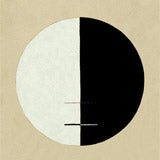
 Circles on Black
 Bauhaus Ausstellung 1923
Kandinsky's work divides into three distinct phases, each with a different visual character and collector appeal.
Munich and the Blue Rider (1908–1914). Expressionistic — bold colour, visible energy, loose form. Kandinsky and Franz Marc organised the first Der Blaue Reiter exhibition in December 1911 after the Neue Künstlervereinigung München rejected his abstract painting. Gabriele Münter's 1957 bequest gave the Lenbachhaus in Munich more than 1,000 Blue Rider works — 90 Kandinsky oils and 330 watercolours and drawings among them — making it the world's primary collection of this period.
Bauhaus years (1922–1933). The most collected phase. Kandinsky joined the Bauhaus in Weimar in 1922, moving with the school to Dessau in 1925 and Berlin in 1932. Composition VIII (1923), Several Circles (1926), and Yellow-Red-Blue (1925) all come from this period. The work is geometric, precise, applied with theoretical rigour: circles, triangles, primary colours, mathematical relationships. This is Kandinsky fully in command of his visual language. The Bauhaus closed under Nazi pressure in 1933.
Paris (1933–1944). Kandinsky fled Germany when the Nazis closed the Bauhaus and settled in Neuilly-sur-Seine. He became a French citizen in 1939. The late work is quieter and more biomorphic — organic shapes closer to Miró than to the angular Bauhaus compositions. Around 50 to 57 of his paintings had been confiscated from German museums in the 1937 Entartete Kunst purge, according to the V&A's research on the Reich Propaganda Ministry's inventory. He died in Neuilly on 13 December 1944, three days short of his 78th birthday.
What Drives Kandinsky's Collector Value
Historical Primacy
Whether or not he was the first abstract painter — a contested claim — Kandinsky wrote the theoretical foundation abstract art has rested on for a century. Every abstract painting owes something to Concerning the Spiritual in Art.
Auction Record
Murnau mit Kirche II (1910) sold at Sotheby's London in March 2023 for £37.2 million ($44.55 million). The work had been restituted to the heirs of Johanna Margarete Stern-Lippmann, murdered at Auschwitz.
Museum Presence
Guggenheim (New York), Centre Pompidou (Paris), Lenbachhaus (Munich), Tretyakov Gallery (Moscow), MoMA (New York). Every major modern art collection in the world has Kandinsky — a reliability signal few twentieth-century names match.
Bauhaus Legacy
The Bauhaus remains the most influential design school of the twentieth century. Owning a Kandinsky from his teaching years connects your wall to that lineage — Klee, Albers, Moholy-Nagy, Gropius, the design language of modern life.
"Colour is the keyboard, the eyes are the harmony, the soul is the piano with many strings. The artist is the hand that plays, touching one key or another, to cause vibrations in the soul."
— Wassily Kandinsky, Concerning the Spiritual in Art (1911)
Browse Kandinsky Prints at Kuriosis →
Choosing the Right Kandinsky Print for Your Room
Kandinsky's Bauhaus work rewards scale. A geometric composition like Circles on Black was designed to be read from across a room — the relationships between shapes only fully come together at a certain viewing distance. At A0 or 70×100cm, the piece breathes; at A3, it can feel crowded. If you have the wall for a larger format, the Bauhaus period is where scale pays off most.
The earlier Munich work — looser, more atmospheric — suits living rooms and bedrooms where warmth matters more than precision. The expressionist colour and visible brushwork translate well to canvas, where the surface texture adds depth to the painterly quality. Bauhaus work, by contrast, reproduces most accurately on fine art paper: the flat colour fields and hard geometric edges stay sharp on the matte surface, without any of the softening that canvas weave introduces.
Frame choice reinforces the period. Black frames sharpen the structure of the Bauhaus-period compositions — the hard edges of Composition VIII or Capricious Form benefit from the graphic contrast. Natural oak complements the warmer palette of the Munich and Paris periods without introducing visual competition. Walnut brown adds a richer, more traditional frame for rooms with classic European furniture.
More Kandinsky prints from our collection:
 Graceful Ascent
 Upward
 Aquarell Exhibition
Why Fine Art Prints? The Kuriosis Approach
Every Kandinsky print we sell is produced in our Berlin studio using archival pigment inks rated for a hundred years of colour stability. Abstract work is unforgiving — any shift in hue, any softening of edge, and the composition falls apart. We calibrate for both.