What Defines Monet's Impressionism
Claude Monet was not just a founding member of Impressionism — he was its most consistent practitioner. While other Impressionists moved between styles and subjects, Monet spent decades studying how light behaves on water, stone, and vegetation at different times of day and in different seasons. The result is a body of work where colour and atmosphere carry more information than line or form.
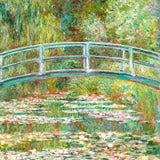
The Giverny paintings — the waterlilies, the Japanese bridge, the artist's garden — represent the culmination of this approach. Morning on the Seine near Giverny captures the river at dawn in layered blues and greens where reflection and surface become indistinguishable. The Corniche near Monaco uses the Mediterranean light to dissolve solid rock into colour. Sun Setting on the Seine builds an entire composition from the relationship between warm and cool light.
Monet's influence on 20th-century painting — from Abstract Expressionism to Colour Field painting — is direct and well-documented. The late waterlily paintings, in particular, anticipate abstraction by decades.
Choosing the Right Format for Monet Prints
Canvas is the natural first choice for Monet's work. The textured surface captures the layered brushwork, impasto technique, and atmospheric colour blending that define Impressionist painting — the canvas format adds a tactile dimension that echoes the original oil paintings. Canvas prints come in 30×40cm, 50×70cm, and 70×100cm, with an optional floating frame.
Fine art paper offers a different quality — the smooth surface brings out the colour precision and tonal range within Monet's compositions, revealing detail that canvas texture can absorb. The waterlily and garden prints, with their subtle colour gradations, read particularly well on paper. Paper prints are available in A3, 50×70cm, 70×100cm, and A0, with oak, black, or walnut brown frames.
Pairing Monet Prints
Monet pairs naturally with the other Impressionists and Post-Impressionists in our collection. Vincent van Gogh is the most obvious companion — both artists studied light and colour with similar intensity, though Van Gogh's approach is more emotionally charged where Monet's is observational. For a broader Impressionist grouping, explore our Impressionism collection.
The garden and waterlily scenes also connect to our botanical collection — Monet's flowers are painted rather than illustrated, but the subject matter creates a visual bridge between artistic traditions. Two or three Monet landscapes in matching oak frames create a contemplative set — the consistent palette and atmospheric approach hold the grouping together naturally.
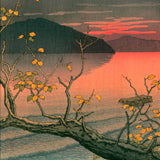
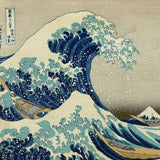
For context on Monet's influence on Japanese art appreciation in France, his work makes a historically interesting companion to Hokusai and Hiroshige — Monet was an avid collector of Japanese woodblock prints, and their influence is visible throughout his compositional approach.
All prints are produced in our Berlin studio using archival pigment inks rated for 100+ years.


 Morning on the Seine near Giverny by Claude MonetFrom CHF 23.00 /
 The Artist's Garden in Giverny by Claude MonetFrom CHF 23.00 /
 Sun setting on the Seine by Claude MonetFrom CHF 23.00 /
 View of Vétheuil by Claude MonetFrom CHF 23.00 /
 The Corniche near Monaco by Claude MonetFrom CHF 23.00 /
 Waterlillies by Claude MonetFrom CHF 23.00 /
 Bouquet of Sunflowers by Claude MonetFrom CHF 23.00 /
 Bridge Over a Pond of Waterlillies by Claude MonetFrom CHF 23.00 /
 The Artist's Garden by Claude MonetFrom CHF 23.00 /