Artist Spotlight · 8 min read · Kuriosis Studio Team, Berlin · June 2026
On New Year's Day 1895, a theatrical poster went up across Paris and changed its designer's life overnight. The poster was for Sarah Bernhardt's Gismonda; the designer was a virtually unknown Czech illustrator named Alphonse Mucha, filling in at a print workshop over the Christmas holidays because the regular artists were all away. Within days, people were bribing bill-stickers for copies. Within weeks, Bernhardt had signed him to a six-year exclusive contract. Within a year, the Paris press had named his immediately recognisable visual style le Style Mucha.
From Moravia to Paris — Mucha's Early Years
Alphonse Mucha was born on 24 July 1860 in Ivančice, Moravia — then part of the Austrian Empire, now the Czech Republic. His father was a court usher; his earliest significant talent was musical, and he received a choral scholarship to the gymnasium in Brno where he met the future composer Leoš Janáček. Rejected by the Prague Academy of Fine Arts, he took work as a scene painter in Vienna, then studied at the Munich Academy of Fine Arts on a scholarship from Count Eduard Khuen Belasi.
He arrived in Paris in 1887 and studied at the Académie Julian and Académie Colarossi, supporting himself through magazine illustration. In the early 1890s he frequented Madame Charlotte's crémerie on the Left Bank, a gathering place for artists that included Paul Gauguin — with whom he briefly shared a studio on rue de la Grande Chaumière in 1893. He was thirty-four years old, modestly employed, and entirely without fame when the call came in from Lemercier's print workshop in December 1894.
The Gismonda Night — How a Last-Minute Brief Changed Art History
The circumstances are well documented by the Mucha Foundation. On 26 December 1894, with Bernhardt's production of Gismonda opening 4 January 1895 and no poster yet printed, the theatre called Lemercier's workshop in desperation. All the regular designers were on holiday. Mucha was pressed into service.
What he produced in under a week was unlike any theatre poster Paris had seen. He portrayed Bernhardt as a Byzantine noblewoman, full-length in a tall narrow format — a proportion never used for theatrical advertising before — in subtle pastels with an orchid headdress and a palm branch, calm and still where the posters of the era were energetic and saturated. The design was "almost like a religious image," as the Encyclopaedia Britannica notes — sinuous line, contained colour, the figure as an ornamental whole.
Bernhardt called it the work of a genius and signed him to an exclusive six-year contract. Over the next six years, Mucha designed the posters, costumes, and stage sets for her productions of La Dame aux Camélias, Medea, Hamlet, and others. He also began producing panneaux décoratifs — decorative panels without text, intended purely for home display and sold at accessible prices. The Seasons (1896) was the first and most famous of these series. As he described his own ambition: "I was happy to be involved in an art for the people and not for private drawing rooms. It was inexpensive, accessible to the general public, and it found a home in poor families as well as in more affluent circles."
 The Seasons
 Bières de la Meuse
The Visual System of Art Nouveau — What Makes Mucha's Style Work
Mucha did not consider himself an Art Nouveau artist. When asked about the movement, he reportedly replied: "What is it, Art Nouveau? Art can never be new." His deepest ambition was always the Slav Epic — twenty monumental canvases depicting the history of Slavic peoples, which he worked on from 1910 to 1928. But his commercial decorative work, which he regarded as a means to an end, defined an entire visual era and continues to define it.
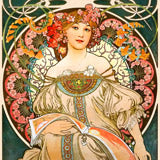
His formal vocabulary is consistent and immediately recognisable. Near-life-size female figures — idealized, serene, never dramatic — occupy the centre of tall vertical compositions. Their hair fills the frame in flowing arabesque curves; botanical borders of orchids, lilies, and ivy tendrils weave through the design. The backgrounds are flat and two-dimensional: Byzantine mosaic patterns, circular halos or aureoles, Gothic-arch frames. The palette is pastel — soft golds, sage greens, warm pinks — startlingly quiet against the saturated poster conventions of his era.
Typography was integral, not added. Mucha hand-lettered text so it curved with the image, making words part of the ornamental whole rather than a label attached to a picture. He worked from photographs of costumed models, which gave his figures their combination of physical specificity and decorative idealization. His Documents Décoratifs (1902) — 72 plates laying out his formal principles — functioned as a manual that spread his visual vocabulary across Europe, and its influence on commercial design has never fully faded.
The Victoria and Albert Museum holds his work in its permanent collection, including the JOB cigarette paper poster (1898) and the La Plume calendar (1897) — two of the clearest demonstrations of his ability to make commercial advertising into decorative objects that people wanted to own.
Browse Alphonse Mucha Prints at Kuriosis →
What Collectors Value in Mucha's Work
Mucha's prints occupy a rare position: they were designed from the outset for ordinary homes, not private drawing rooms, and that democratizing intention has driven their market continuously since the 1890s.
Designed for Walls
Mucha explicitly created his decorative panels as affordable art for domestic display. The panneaux décoratifs series — the Seasons, the Flowers, the Arts — were never theatrical posters. They were made for living rooms, and they work in them.
Visual Universality
His aesthetic is simultaneously feminine and decorative without being domestic, historical without being cold, ornate without being cluttered. The pastel palette works with a wide range of interior contexts and does not age into a period piece.
Cultural Continuity
Mucha's visual language was revived by the 1960s psychedelic poster artists — who consciously drew on his sinuous lettering and female-figure-with-halo compositions — and has remained in continuous active production and cultural reference ever since. The V&A, the Mucha Museum in Prague, and the National Gallery Prague all hold permanent collections.
Collector Market
Original lithographic prints command significant auction premiums — a Seasons series (1897) recently sold at $3,400–$4,300 per panel. Fine art reproductions bring the same compositions into homes at a fraction of the cost of period originals.
"I was happy to be involved in an art for the people and not for private drawing rooms. It was inexpensive, accessible to the general public, and it found a home in poor families as well as in more affluent circles."
— Alphonse Mucha
Beyond the Poster — The Commercial Works and the Slav Epic
Mucha's commercial output extended well beyond theatrical posters. He designed jewellery for Georges Fouquet, whose flagship boutique on Rue Royale — described by the Mucha Foundation as "a summit of Art Nouveau decoration" — he designed in its entirety in 1901. He created advertising campaigns for Moët & Chandon, JOB cigarette papers, and Chocolat Idéal. He designed the first stamps, banknotes, and state symbols for independent Czechoslovakia in 1918 — often at personal cost, as an act of patriotism.
His most personal work was the Slav Epic: twenty monumental canvases, some as large as 8 × 6 metres, depicting the spiritual and cultural history of the Slavic peoples from mythological prehistory to the 20th century. He worked on them from 1910 to 1928, funded almost entirely by the American industrialist and Slavophile Charles Richard Crane. Upon the first exhibition in 1919, Mucha described his intent: "Let it announce to foreign friends — and even to enemies — who we were, who we are, and what we hope for." He donated the complete cycle to Czechoslovakia on its tenth anniversary of independence. He died in 1939, ten days before his 79th birthday, under Gestapo arrest following the German occupation of Prague.
The poster career he saw as secondary remains his most visible legacy. La Plume and Champagne Ruinart are among the works where his commercial and artistic aims aligned most completely — objects made for an advertising brief that became, in practice, collector's prints.
More works from the Mucha collection:
 Champagne Ruinart
 Chocolat Idéal
 Fruit
Fruit
Why Fine Art Prints? The Kuriosis Approach
Every Mucha print in our collection is produced in our Berlin studio using archival pigment inks on 225g fine art paper — the matte surface preserves the intricate line work and layered pastel colour that define his decorative panels. Explore the full Mucha collection here.
Sources & Further Reading
- Wikipedia — Alphonse Mucha — Biography, Paris career, technique, Slav Epic, death
- Mucha Foundation — Alphonse Mucha Timeline — Authoritative chronology, Gismonda commission, Bernhardt contract, Slav Epic
- Encyclopaedia Britannica — Alphonse Mucha — Style analysis ("supple, fluent draftsmanship," whiplash lines), Pre-Raphaelite influence
- Victoria and Albert Museum — Art Nouveau Collections — V&A holdings including JOB poster (1898) and La Plume (1897)
- Wikipedia — The Slav Epic — Scale, production history, Mucha quote on purpose, current location