BUYING GUIDE · 11 min read · Kuriosis Studio Team, Berlin · October 2026
The enemy of bathroom wall art is the air after a hot shower. It can reach 100 % humidity within minutes and settles on anything colder than itself, including the inside of a picture frame. This guide explains what that does to a paper print, which frame and finish cope with it, where in the room a print is safe, and what size fits a small bathroom.
The short answer
You can hang an art print in a bathroom if the room has an extractor fan or a window you actually open, and the print hangs away from the shower and the bath. The number to remember is 65 %: that is the ceiling the Canadian Conservation Institute sets for paper, above which mould becomes a realistic risk, so the aim is to get the room back under it soon after showering. The same institute notes that any spell below 55 % stops mould growth. Frame the print with an acrylic front, keep the paper from touching it, and hang it on an inside wall above the toilet or the basin, with its centre at about 145 cm. In a small bathroom one A3 print (29.7 × 42 cm) is enough.
Can you hang art prints in a bathroom?
Yes, with ventilation and the right spot. Paper is the problem material here. The Canadian Conservation Institute advises keeping relative humidity below 65 % for paper and warns that mould can take as little as two days to grow at 90 % and about ten days at 80 %. Damp air also makes paper swell and cockle, and at 90 to 100 % ink and watercolour can start to bleed. The Institute of Conservation puts the ideal for art on paper at 45 to 60 % and says that in a home a stable level under 60 % is what matters.
A bathroom leaves that range every time someone showers. A Japanese study of bathroom climate presented at Healthy Buildings 2006 found that humidity in the room reaches 100 % immediately after a shower, with 900 to 1,300 g of water released per bath. A conservation researcher who put a sensor in their own bathroom for two months saw the reading jump from 44 % to more than 75 % during a six-minute shower and take about three hours to come back down. A test frame in that bathroom cracked along one mitre the first time the reading hit 100 %. That is one household, so treat it as an example.
The damage happens where the warm air meets something cold. The Canadian Conservation Institute gives the arithmetic: air at 50 % humidity cooled by 10 °C is at 100 %, and any further cooling condenses water onto the object. Inside a frame, the cold object is the glass. So two things decide the outcome: how fast the room dries out, and what sits between the steam and the paper.
Ventilation first. England's building regulations ask for an extractor in every bathroom that pulls at least 15 litres of air per second when it runs intermittently, mounted no more than 400 mm below the ceiling (Approved Document F, 2021). If your fan is older or weaker than that, run it during the shower and leave it on for an hour afterwards, and close the bathroom door so the steam does not travel. The US Environmental Protection Agency sets the household target at under 60 %, ideally 30 to 50 %. A cheap hygrometer on the bathroom shelf tells you whether your room gets there.
Framed paper print or canvas print: which survives steam better?
A framed paper print behind acrylic, with the paper held off the front and the back sealed, is the safer choice in a bathroom. The frame works as a buffer: the Canadian Conservation Institute notes that typical frames protect against short-term fluctuations, which is exactly what a shower is. Three details make the difference.
The front. The CCI's note on glazing says the inside of glass is subject to condensation that can transfer to the paper. Acrylic is lighter and does not shatter if it slips on a tiled floor, but it scratches more easily and holds static, so clean it with an acrylic or anti-static cleaner on a soft cloth, never a dry paper towel. Our frames come with a 2 mm acrylic front.
The gap. The paper must not touch the front. The CCI's framing guidance calls for a window mount or a spacer, because contact can leave pigment on the glazing or make the sheet stick to it. If condensation ever forms, the gap keeps the water off the print.
The back. The same note recommends sealing the frame with tape to keep out dust and airborne pollution, and the CCI's guidelines for paintings say a sealed backing board is what buffers short-term swings in humidity. The CCI's photo of mould colonies on the back of a poorly framed print is the picture to keep in mind. The Library of Congress lists a moisture barrier of polyester film among the parts of a preservation frame, alongside the backing board.
A canvas print has no front at all, so the cotton takes the air directly. The CCI's guidelines for paintings put the safe range for canvas at 40 to 60 %, expect mould above 70 to 75 %, and describe how above 75 % a canvas shrinks while its wooden stretcher expands, which strains the paint layer. For a bathroom that dries quickly, Hunker's advice on canvas is a small gap to the wall so air moves behind it; no conservation body endorses canvas in a bathroom. In a windowless shower room with a weak fan, choose the framed paper print. Our guide to canvas prints and art prints covers the two finishes in other rooms.
Where should art go in a bathroom?
Above the toilet or next to the basin, on an inside wall, out of reach of splashes. Ideal Home's bathroom guide calls the wall above the toilet a failsafe spot and quotes interiors expert Kate Conrad: avoid hanging pieces directly above the shower or bathtub, and choose a spot further from the water, such as above the toilet or sink. Art advisor Kelly Cahn tells Livingetc that high humidity leads to discoloration, mould and peeling, and the magazine names sinks and splash zones as the first places it happens, so keep a print above the line where water can land.
Pick the wall as carefully as the spot. The Institute of Conservation advises against hanging pictures on the inside of an outside wall, because the colder surface causes condensation and mould inside the frame. In a bathroom that is the wall with the window. The wall shared with the hallway or the bedroom stays warmer. Keep the frame away from the towel radiator too: heat dries the air next to it and its convection currents carry dirt onto the frame.
Height follows the usual rule. Hang the print so that its centre is at about 145 cm from the floor, the level that gallery and design guides quote because it matches average eye height; 145 to 152 cm is the range the guides quote. Above a toilet or a basin, leave 15 to 20 cm between the top of the cistern or the splashback and the lower edge of the frame. Real Homes gives that gap for furniture, and it stops the frame from sitting in the wet zone above a tap.
If the wall is tiled, drill through the middle of a tile rather than the edge, and put a strip of tape over the mark so the bit does not skid. Homes & Gardens suggests the middle of the tile to stop it cracking.
What size wall art for a small bathroom?
A small bathroom takes one print, A3 or 50 × 70 cm, hung alone. The room is viewed from a metre or two, often while you stand at the basin, and a crowded wall feels smaller still. James Ryan of Grove Gallery tells Ideal Home to choose one single piece in a small bathroom and to save the gallery wall for a large one. For the strip of wall above a toilet, A3 (29.7 × 42 cm) in portrait format fits between the cistern and the ceiling with room to spare. Above a bath on a long wall, where you see the print from across the room, 50 × 70 cm works, as long as it hangs outside the splash zone. The viewing-distance rule we use is in our hallway guide: about 1 m for A3 and 1.7 m for 50 × 70 cm.
Larger bathrooms can take a row. Homes & Gardens suggests three larger or five smaller pictures in a line, an odd number, and says that more than that makes the room feel cluttered. Keep the frames in one colour and the same size, so the row reads as one piece.
Ventilation
Ventilation decides whether art belongs in your bathroom. A fan at 15 litres per second or an open window, running during the shower and for an hour after. If the room stays above 65 % for most of the day, hang the print somewhere else.
Frame
Acrylic front, a mount or spacer so the paper never touches it, and a taped back. Oak and brown suit tiles in warm tones and wooden vanities, black suits white tiles and chrome. Whatever the colour, hang it with small bumpers so air moves behind the frame.
Spot
Above the toilet or beside the basin, on an inside wall, centre at about 145 cm, 15 to 20 cm above the cistern or splashback. Never above the bath or inside the shower's line of sight, and not above the towel radiator.
Motif
Water, sea and bathing subjects match the room. Blues and greens sit well against white tiles; a single bold print reads better from the basin than a pale, detailed one.
 Morning of Cape Inubo by Hasui
 Antique Blue Whale
 Yoro Waterfall by Hokusai
What pictures should you hang in a bathroom?
Water subjects, which is where most bathroom wall art ideas start, because the room already has the colours. Japanese landscape prints are the obvious start. Kawase Hasui's Morning of Cape Inubo from 1931 puts a red sun over a green sea, and the National Museum of Modern Art, Tokyo holds an impression of it. Hokusai's Yōrō Waterfall belongs to his series on the waterfalls of the provinces, made around 1832 to 1834 in the newly imported Prussian blue; the Metropolitan Museum of Art dates its sheet to about 1832. Taguchi Tomoki's Blue Lake is almost nothing except water and a few birds, which is what a small white room can take.
Bathing itself has a long run in print. Hashiguchi Goyō, the shin-hanga designer who died in 1921, made only fourteen prints, and women at their bath and at their dressing table are among them. Julius Klinger drew for the Berlin satirical weekly Lustige Blätter while he worked in the city between 1897 and 1915; the striped bathing costume at the top of this page is one of his drawings for it. Both suit a bathroom, where the subject matches the room.
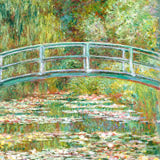
Painted water works too, on paper or on canvas. Monet's Bridge over a Pond of Water Lilies dates from 1899 and hangs at the Met; Seurat painted his harbour at Port-en-Bessin in 1888 as a series of six views at different tides. Natural-history plates are the other family: whales, octopuses and jellyfish drawn for encyclopaedias, like the Poulpe Colossal dragging a ship under. Our studio started with a jellyfish plate on a market table, so we have a soft spot for them.
Common mistakes with bathroom art
Most bathroom art fails for one of five reasons, and four of them are about air.
No fan, door shut, print stays wet. The CCI's mould table says it plainly: about 100 days at 70 %, 10 days at 80 %, two days at 90 to 100 %. A room that never dries will grow mould on the back of the frame before you see it on the front. Fix the ventilation first or hang the print in the hallway.
Above the bath. Hunker's advice on canvas makes a fair point that steam travels and distance alone does not save a print. Distance does stop splashes, and the bath is where they come from. Move the print to the toilet wall.
Paper against glass. A cheap frame presses the print onto the glazing. Condensation forms on the inside of the glass, the sheet sticks, and the image comes away with it. Insist on a mount or spacer.
On the outside wall. The wall with the window is the coldest in the room, and cold walls are where condensation sits. Use the wall shared with a heated room.
Too many small frames. Six postcard-sized prints over the toilet look like a noticeboard. One A3 print, or three matched frames on a long wall, reads calmer from the basin.
Quieter prints for the wall above the basin:
 Woman Applying Rouge by Goyō Hashiguchi
 Seascape at Port-en-Bessin by Georges Seurat
 Floating Away by Julia Charlott
Questions
How do you protect art from bathroom humidity?
Keep the room under 65 % with a fan, frame the print behind acrylic with a mount so the paper never touches the front, tape the back, and hang it on an inside wall away from the shower. The frame buffers the short spikes after a shower; the ventilation handles the rest.
Can you hang art in a bathroom without a window?
Only with a working extractor fan. England's regulations ask a wet room with no outside wall to change its air four times an hour, and they allow humidity-controlled fans in bathrooms, which switch themselves on when the air gets damp (Approved Document F). If your room has neither, it will sit above 65 % for long stretches, and paper should not live there. A canvas print with a gap behind it tolerates slightly more, but it is still a compromise.
Does a framed print need to breathe?
No. A sealed back and a front that keeps out water vapour are what conservators ask for, because the frame then buffers the room's swings. The space behind the frame needs air, so hang it on bumpers and keep it off a cold wall.
How we make them
Every print on this page is made in our own studio in Berlin, with archival pigment inks on Fine Art Paper or canvas. We print, frame and pack each one ourselves, and we are happy to tell you which finish suits your bathroom if you send us a photo of the wall.
Sources & Further Reading
- Canadian Conservation Institute: Caring for paper objects (humidity limits, mould timing, cockling)
- Canadian Conservation Institute: Agent of deterioration, incorrect relative humidity
- Canadian Conservation Institute: Glazing materials for framing works on paper
- Canadian Conservation Institute: Framing works of art on paper
- Canadian Conservation Institute: Environmental and display guidelines for paintings (canvas)
- Institute of Conservation (UK): Caring for your treasures, art on paper
- Library of Congress: Preservation matting and framing
- HM Government: Approved Document F, Volume 1, Ventilation (2021 edition)
- US Environmental Protection Agency: A brief guide to mold, moisture and your home
- Aizawa et al.: Thermal environment and moisture production in the bathroom, Healthy Buildings 2006
- Conserv: Art in the bathroom? Examining a microclimate (two-month household measurement)
- Ideal Home: Bathroom wall art ideas to safely and stylishly decorate
- Livingetc: How high should you hang art?
- Homes & Gardens: Bathroom art ideas
- The Metropolitan Museum of Art: Hokusai, Yōrō Waterfall in Mino Province
- Wikipedia: Hashiguchi Goyō