BUYING GUIDE · 7 min read · Kuriosis Studio Team, Berlin · October 2026
Hallway wall art has a harder job than art anywhere else in the home. You walk past it many times a day, usually from about a metre away and often under a single ceiling light. That changes which print sizes work and how high they hang, and it favours clear lines over subtle colour.
The short answer
Let the distance decide the size: in most hallways that means A3 prints on the side walls and one larger print on the wall facing the front door. A useful rule of thumb comes from the exhibition guidelines of Glasgow Museums: where possible, allow a viewing distance of at least twice the diagonal of an image. For our sizes that means about 1 m for A3, 1.7 m for 50 × 70 cm and 2.4 m for 70 × 100 cm. Hang every print with its centre at about 145 cm from the floor.
What size art works in a narrow hallway?
In a narrow hallway, A3 (29.7 × 42 cm) in portrait format is the size you can take in at a glance. Many hallways are not much wider than the 90 cm of clear width that England's building guidance asks for in accessible homes (Approved Document M), so you rarely stand more than a metre from the wall. On a side wall you never get far enough back from a 70 × 100 cm print to see it as a whole.
Portrait formats also fit the way hallways are built. Doors, light switches and radiators cut the long wall into strips, and a strip between two doors is often only 60 to 90 cm wide. A portrait print fills that strip without crowding the door frames. We leave at least a hand's width between a frame and a door frame or switch.
The short distance helps one kind of motif. Fine line work that gets lost across a living room reads well from a metre, which is why botanical plates and woodcuts do so well here. Ernst Haeckel's Tineida Moths is a good example: from the sofa it looks like a grey pattern, and from the hallway you see the fine lines of each wing.
One large print or several small ones?
Use both: one larger print on the wall facing the front door, and a row of smaller prints along the side walls. The end wall is the only hallway wall people see from a few steps back. If there are about 2.5 m between the door and that wall, a 70 × 100 cm print works there. Posters with bold graphics suit this spot. Julius Klinger's flamingo for the Zoologischer Garten, the print at the top of this page, reads well from the doorway, and so does Alphonse Mucha's beer advertisement for Bières de la Meuse.
The long side walls suit a row. We hang two or three prints of the same size, in the same frame colour, with 5 to 8 cm between them, so they read as one group as you walk. Prints by one artist make the easiest pairs. Julie de Graag's woodcuts Zonnebloem and Kale boom share the same black line and hang well side by side.
If there is a sideboard or bench in the hallway, let the furniture set the width: the print or group should cover about two thirds of it. We leave 20 to 25 cm between the top of the furniture and the lower edge of the frame. Our art print size guide uses the same two-thirds rule above a sofa.
How high should you hang pictures in a hallway?
Hang hallway art with its centre at about 145 cm from the floor. Museums use this height for visitors who are standing, and the hallway is the one place at home where you always look at art standing up. The McMaster Museum of Art puts the centre at 137 to 142 cm (54 to 56 inches). The installation guidelines of the Minneapolis College of Art and Design use 147 cm (58 inches). It is tempting to go higher in a narrow corridor to keep frames out of the way. Then people have to look up to see the print, and in a corridor they rarely stop to do that.
In a row, line up the centres. If the frames have different heights, a shared centre line keeps the group calm. Draw one light pencil line at 145 cm and hang every centre on it. Our guide to seven ways of hanging art prints shows how a row compares with a grid or a salon wall.
How high should you hang pictures on a staircase?
On a staircase, keep each print at the same height above the step directly below it. We do it like this: measure about 145 cm up from the front edge of the step under each frame and mark the centre there. The marks form a line parallel to the handrail. Keep the same horizontal gap between the frames, so the row climbs at the angle of the stairs.
The wall of a landing is often seen from the foot of the stairs, three or four metres away. By the same rule of twice the diagonal, that distance carries a 70 × 100 cm print, so the landing is the place for the largest piece on the staircase. Keep one frame colour from the bottom step to the landing, so the group still reads as one when the sizes change.
Viewing distance
Measure from the wall to where you usually stand. About 1 m suits A3, 1.7 m suits 50 × 70 cm and 2.4 m suits 70 × 100 cm. In a corridor that point is the opposite wall; for the end wall it is the front door.
Light
When Tate lends works on paper, it allows 50 lux and no direct sunlight, so a hallway with little daylight is good for paper prints. Under one ceiling light, woodcuts and bold posters read better than pale watercolour tones.
Wall rhythm
Mark doors, switches and radiators on the wall first. Plan one print or one pair for each strip of wall between them, and leave a hand's width to every door frame. The same frame colour along the whole corridor holds it together.
Frame
Oak warms a white hallway and matches wooden floors. On light walls black gives the most contrast, and in older buildings with dark doors brown fits better. Whatever you choose, use one colour for the whole hallway so the prints read as a set.
 Bières de la Meuse by Alphonse Mucha
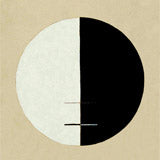
 Am 2 by László Moholy-Nagy
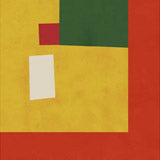
 Composition with Large Blue Plane by Piet Mondrian
Common mistakes with hallway art
Most hallway mistakes come from height and distance: prints hung too high, or too big for the space in front of them.
Hanging too high. A centre at 170 cm puts the print above most people's eyes. Bring it down to about 145 cm.
One small print alone on a long wall. A single A3 on three metres of wall looks lost. Use a row of three, or move it into a strip between two doors where it fills the space.
Too big for the corridor. By the museum rule, a 70 × 100 cm print needs about 2.4 m of viewing distance. On the side wall of a 1 m corridor, move it to the end wall or choose A3.
Hanging above the radiator. Hallways often have one, and it looks like a natural spot. The Fine Art Trade Guild says pictures should ideally not hang above radiators, because rapid changes in temperature dry out paper and wood and make adhesives fail. It also advises against hanging them directly opposite large windows, because sunlight fades colours and discolours paper.
Ignoring reflections. A frame opposite a glass front door or under a spotlight can reflect so much light that you barely see the print. Ordinary float glass reflects about 8 % of visible light, according to the FACTS glazing standard that the Fine Art Trade Guild publishes. Check the spot in the evening with the hallway light on before you drill. Our frames have a 2 mm acrylic front instead of glass. Acrylic is lighter and less likely to break when a bag or a shoulder knocks the frame, but it reflects about as much light as glass, so the evening check still matters.
Quieter prints for a row along the long wall:
 Tineida Moths by Ernst Haeckel
 Leaves from Nature No. 1 by Owen Jones
 Kale boom by Julie de Graag
How we make them
Every print on this page is made in our own studio in Berlin, with archival pigment inks on Fine Art Paper or canvas. We print and pack each one ourselves, so it has been through our hands before it reaches your hallway.
Sources & Further Reading
- Tate: Care and treatment of loaned artworks (light levels for works on paper)
- Canadian Conservation Institute: Light, ultraviolet and infrared
- McMaster Museum of Art: Preparator tips on hanging height and spacing
- Minneapolis College of Art and Design: Installing artwork guidelines
- Fine Art Trade Guild: Framing information and advice
- Fine Art Trade Guild: FACTS standard for glazing materials
- Glasgow Museums: Display guidelines, viewing distance (copy hosted by the British Museum International Training Programme)
- Canadian Conservation Institute: Glazing materials for framing works on paper
- UK Government: Approved Document M, Volume 1 (hallway widths)