Katsushika Hokusai began producing his most significant woodblock work in his fifties and considered everything before that a warm-up. The Great Wave is the most reproduced Japanese artwork in history — but the wider Thirty-Six Views of Mount Fuji series reveals the full range of his compositional ambition.
Hokusai changed his artist name over 30 times during his career — a deliberate practice of reinvention. He produced ukiyo-e prints, paintings, book illustrations, and sketches across a working life that lasted more than seventy years. He died at 88, reportedly still working, and famously claimed that nothing he made before the age of seventy was worth counting.
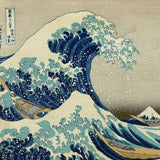
The Great Wave off Kanagawa is his most famous image and the most reproduced Japanese artwork in existence. The composition is mathematically precise — the wave's curve, the positioning of Mount Fuji beneath it, the three boats caught in the trough. This is controlled drama, not spontaneous expression. The image influenced the French Impressionists, Art Nouveau designers, and continues to appear in contemporary design and illustration.
The wider Thirty-Six Views of Mount Fuji series rewards exploration beyond the canonical images. Hokusai set himself a single compositional problem — Mount Fuji seen from different locations, in different weather, at different times of day — and solved it in forty-six prints (the series expanded beyond its original thirty-six). The variations in mood, colour, and perspective demonstrate why the series is considered one of the great achievements of printmaking.
Choosing the Right Format for Hokusai Prints
Fine art paper is the clear choice for ukiyo-e woodblock reproductions. The smooth matte surface preserves the flat colour fields, precise outlines, and subtle gradations that define the original printing technique — woodblock prints were designed for paper, and they read most accurately in that medium. Paper prints are available in A3, 50×70cm, 70×100cm, and A0, with oak, black, or walnut brown frames.
The larger formats — 70×100cm and A0 — let you appreciate the compositional detail that is lost at smaller sizes: the texture of the wave's spray, the fine lines of distant landscapes, the calligraphic cartouches. Natural oak frames complement the warm tones of the original colour palette. Black frames suit the more graphic compositions with strong outlines and high contrast.
Pairing Hokusai Prints
Two or three prints from the Thirty-Six Views series in matching frames create an immediately cohesive wall arrangement. The consistent subject — Mount Fuji — ties the pieces together while the variation in weather, colour, and composition keeps the grouping visually interesting.
Hokusai pairs naturally with other Japanese woodblock masters in our collection. Hiroshige's landscape prints share the ukiyo-e tradition but with a softer, more atmospheric sensibility. Hasui Kawase extended the landscape tradition into the 20th century with the shin-hanga movement. For the full range of Japanese art — from Edo-period woodblock through Meiji painting to shin-hanga — explore our Japanese prints collection.
For rooms with a Japandi or minimalist aesthetic, Hokusai's muted mountain views and atmospheric landscapes work particularly well — their restrained palette and contemplative composition suit interiors where less holds more.
All prints are produced in our Berlin studio using archival pigment inks rated for 100+ years.
A collector's guide to Katsushika Hokusai — the artist who changed his name thirty times, worked until his death at eighty-eight, and produced The Great Wave as one of 46...
From Edo-period ukiyo-e to the 20th-century shin-hanga revival — the history, technique, and collector's guide to Japanese woodblock prints. How they shaped Western art, what to look for when buying,...


 The Great Wave of Kanagawa by HokusaiFrom €23,99 EUR /
 The Floor of the OceansFrom €23,99 EUR /
 Shimotsuke Waterfall by HokusaiFrom €23,99 EUR /
 Yoro Waterfall by HokusaiFrom €23,99 EUR /
 Mount Fuji Red by Katsushika HokusaiFrom €23,99 EUR /
 The Amida Falls in the Far Reaches of the Kisokaidō Road by Katsushika HokusaiFrom €23,99 EUR /
 Irises and Grasshopper by Katsushika HokusaiFrom €23,99 EUR /
 Lilies by Katsushika HokusaiFrom €23,99 EUR /
 Falls of Aoigaoka in the Eastern Capital by Katsushika HokusaiFrom €23,99 EUR /
 Falls of Ono on the Kisokaidō by Katsushika HokusaiFrom €23,99 EUR /
 Enoshima in Sagami Province by Katsushika HokusaiFrom €23,99 EUR /
 Roben Waterfall by HokusaiFrom €23,99 EUR /
 Edo nihonbashi by Katsushika HokusaiFrom €23,99 EUR /
 Fukagawa mannenbashi sita by Katsushika HokusaiFrom €23,99 EUR /
 Peonies and Canary by Katsushika HokusaiFrom €23,99 EUR /
 Kannon Shrine at Kiyo Falls by Katsushika HokusaiFrom €23,99 EUR /
 Sōshū hakone kosui by Katsushika HokusaiFrom €23,99 EUR /