Artist Spotlight · 8 min read · Kuriosis Studio Team, Berlin · April 2026, updated November 2026
Katsushika Hokusai was a Japanese painter and printmaker who lived from 1760 to 1849 and made The Great Wave, his best-known print. Hokusai prints range from that wave to the waterfalls and flower studies of his last decades, and they left their mark on European painting. He died at eighty-eight, reportedly still dissatisfied with his own work. This guide covers his life, the prints, and why they are worth collecting.
We make our Hokusai art prints to order in our Berlin studio, on paper or as a canvas print.
Hokusai is one of several masters in our complete guide to Japanese wall art, which covers the styles and how to choose a print for your home.
A Life of Deliberate Reinvention
Hokusai was born on 31 October 1760 in the Katsushika district of Edo, the city we now call Tokyo. He entered the studio of woodblock print master Katsukawa Shunshō at around eighteen and kept working for the rest of his life. Over more than seventy active years he produced an estimated 30,000 works: woodblock prints, book illustrations, brush paintings and instructional drawing manuals.
He worked under at least thirty names, an unusual number even in a culture where name changes were common. Each name marked a change in approach. "Hokusai", loosely translated as "North Studio", was in use by around 1800 and is the name he is remembered by, though he spent his final fifteen years signing work as "Gakyō Rōjin Manji", the Old Man Mad About Drawing. The Great Wave itself is signed "Hokusai aratame Iitsu hitsu", meaning "Hokusai, renamed Iitsu, painted this", which dates it to the Iitsu period of the early 1830s.
He never stayed in one place for long and reportedly moved house 93 times over the course of his life. When he died in 1849, his reported last words were: "If only Heaven will give me just another ten years... Just another five more years, then I could become a real painter."
The Great Wave: What Makes It Inexhaustible
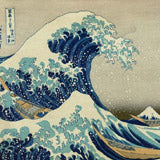
The print formally titled "Under the Wave off Kanagawa" (Kanagawa oki nami ura) appeared around 1831 as part of the series "Thirty-Six Views of Mount Fuji." The publisher Eijudo issued the series, which eventually comprised 46 prints in total, because ten more views were added to the original thirty-six once it proved popular.
The print is small, approximately 25 × 37 cm in the original ōban format. Its sense of scale comes from the composition. The great wave arcs across the image, its foam claws reaching toward three fishing boats. Mount Fuji, geometrically precise and snow-capped, sits small and calm in the background. Hokusai reverses the scale you would expect: the wave is enormous and Fuji is a thumbnail.
The colour comes from Prussian blue, a synthetic pigment developed in Berlin around 1706 and imported into Japan via Dutch traders. The Metropolitan Museum's technical research has shown that printers used a double-printing method: first a mixture of Prussian blue and indigo for the deep outlines, then pure Prussian blue over the remaining areas. The layering gives the blue physical depth, and microscopic scanning shows the ink layers sitting at different heights on the paper.
Debussy kept a print of The Great Wave in his studio. A photograph from 1910 shows it on the rear wall of his Paris studio. When the score of La Mer was first published in 1905, Debussy chose a detail from The Great Wave for the cover, with his name in the calm sky above the wave. The Met has written about this connection in detail.
Our art print of The Great Wave of Kanagawa is made on matte fine art paper. That keeps it close to the woodblock original, which was ink on washi paper.
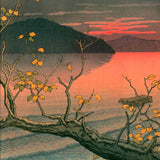
 Mount Fuji Red by Hokusai
 Yoro Waterfall by Hokusai
Why Hokusai Prints Are Worth Collecting
Hokusai's prints matter in art history and are easy to live with on a wall. Four things explain why people keep collecting them.
Compositional Precision
Hokusai studied Dutch copperplate engravings and absorbed Western linear perspective into a Japanese visual tradition. His prints have unusual spatial depth and read as more three-dimensional than their flat format suggests.
Cross-Cultural Influence
Monet owned 23 Hokusai prints. Van Gogh praised his line quality in letters to his brother Theo. Debussy put The Great Wave on his studio wall and on his score.
Depth of Catalogue
The Great Wave is Hokusai's most reproduced image, and there is a lot more behind it. The waterfall series, the flower studies and the Manga volumes of figure drawings deserve as much attention.
Made for Many
Woodblock prints were published in large runs for a wide audience, and Hokusai's were no exception. Early impressions of The Great Wave now sell at auction for millions. A fine art print is the practical way to live with the image.
"From the age of six, I had a passion for copying the form of things… At seventy-three years I partly understood the structure of animals, birds, insects and fishes, and the life of grasses and plants… at ninety I shall even further penetrate their secret meaning."
Katsushika Hokusai, postscript to One Hundred Views of Mount Fuji, 1834
Browse Hokusai Art Prints at Kuriosis →
Beyond the Wave: Waterfalls, Flowers and the Manga
Hokusai made far more than The Great Wave, and the work around it deserves time.
A Tour of the Waterfalls of the Provinces (ca. 1833) has some of his boldest compositions. Each print builds a different waterfall in a different way: the Yoro Waterfall in Mino, the Amida Falls with their steep cascade, and the Ono Falls on the Kisokaidō road. Our art print of The Amida Falls in the Far Reaches of the Kisokaidō Road shows what the series does. The waterfall becomes an almost abstract vertical form, the human figures are there for scale, and the forest presses in from both sides.
The Hokusai Manga, fifteen volumes of sketched figures, animals, plants, landscapes and supernatural subjects published from 1814 onward, were instruction manuals for amateur artists. Britannica describes them as copybooks for amateur artists, with thousands of individual drawings. When Japan opened its ports to foreign ships in 1854, the Manga volumes were among the first Japanese printed works to reach European artists and collectors, and they made a strong impression.
Late in his life Hokusai began work on the One Hundred Poems Explained by the Nurse, a series illustrating classical waka poems from the thirteenth-century anthology Hyakunin Isshu. He was in his mid-seventies when he started it. Only 27 of the intended 100 prints were completed before his death. The Smithsonian holds his preparatory drawings for the series, and the Metropolitan Museum holds prints from it. Lilies by Katsushika Hokusai shows how economical his line had become in these years.
More Hokusai art prints from our collection:
 The Amida Falls by Hokusai
 Lilies by Katsushika Hokusai
 Kannon Shrine at Kiyo Falls
Questions
What was Hokusai's full name?
Katsushika Hokusai. Katsushika is the district of Edo where he was born in 1760, and Hokusai, loosely "North Studio", is the best known of at least thirty artist names he used.
Is The Great Wave a painting?
No, it is a woodblock print. It appeared around 1831 in the series Thirty-Six Views of Mount Fuji, and the original sheet measures approximately 25 × 37 cm.
How old was Hokusai when he made The Great Wave?
He was about seventy. Hokusai was born in 1760 and the print appeared around 1831, in the years when he signed his work as Iitsu.
How many prints are in Thirty-Six Views of Mount Fuji?
There are 46. Ten more views were added to the original thirty-six because the series was popular.
Why Fine Art Prints? The Kuriosis Approach
Woodblock printing was a commercial medium, and series like the Thirty-Six Views were printed in large numbers. We make every Hokusai art print and canvas print to order in our Berlin studio, with Japanese pigment inks rated to last more than 100 years. Frames come in oak, black and brown, and for Hokusai a slim black or oak frame suits the clean lines of the compositions.
Sources & Further Reading
- Metropolitan Museum of Art: The Great Wave, Anatomy of an Icon (technical analysis, Prussian blue printing, Debussy connection)
- Metropolitan Museum of Art: Debussy, La Mer and The Great Wave (studio photograph, score cover)
- Wikipedia: A Tour of the Waterfalls of the Provinces, the waterfall series of ca. 1833
- Fondation Claude Monet, Giverny: Monet's collection of Japanese prints
- Wikipedia: Katsushika Hokusai, full biography, name chronology, Western influence, and quote sources
- Wikipedia: The Great Wave off Kanagawa, technical details, surviving impressions, auction history
- Encyclopaedia Britannica: Hokusai, Thirty-Six Views series, Manga volumes, late career assessment
- Smithsonian National Museum of Asian Art: One Hundred Poems, record of a preparatory drawing