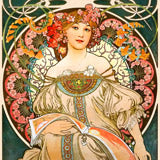
Gustav Klimt's gold-leaf compositions redefined European decorative art at the turn of the twentieth century. As co-founder of the Vienna Secession, he rejected academic tradition in favour of ornamental intensity and erotic charge. The Kiss, Judith, the Attersee landscapes — each work treats the picture surface as much as design object as painting.
Gustav Klimt worked at the intersection of fine art and decorative design. As co-founder of the Vienna Secession in 1897, he rejected academic tradition in favour of ornamental intensity. The gold leaf in The Kiss and Portrait of Adele Bloch-Bauer wasn't decorative excess — it was a deliberate refusal to create pictorial depth, dissolving the boundary between figure and pattern. His subjects — the female figure, erotic tension, the cycle of life and death — were consistently transgressive for Vienna around 1900.
Beyond the iconic gold-phase portraits, Klimt's landscape paintings reveal a quieter, impressionist side. The Attersee lake scenes, Beech Grove, Pear Tree — these works use dense, mosaic-like brushwork and muted greens that differ sharply from the gold compositions. Our collection includes both sides: the famous figure paintings that draw buyers in, alongside the lesser-known but equally compelling landscapes that often end up being the stronger choice for a living space.
Choosing the Right Format for Klimt Prints
The gold-phase works read exceptionally well on 400g cotton canvas, where the surface texture adds painterly warmth that echoes the layered quality of the originals. The Kiss at 70×100cm gives the gold detailing room to breathe. Canvas prints are available in 30×40cm, 50×70cm, and 70×100cm, with an optional floating frame for a gallery finish. The floating frame adds a 5mm shadow gap that gives the print a museum-quality edge.
On 225g matte fine art paper, the graphic precision of Klimt's ornamental patterns comes through with sharp clarity — the geometric motifs in clothing and backgrounds reveal detail that rewards close viewing. Paper prints are available in A3, 50×70cm, 70×100cm, and A0, with oak, black, or walnut brown frames. The A0 format is particularly striking for the Attersee landscapes, where the mosaic brushwork fills the surface.
Pairing and Displaying Klimt Prints
Black frames complement the gold tones without competing. Natural oak works well with the landscape paintings and their warm earth palette. A pair of Klimt works — one gold-phase portrait alongside an Attersee landscape — creates visual contrast while staying within a single artist's vision. Walnut brown suits the darker, more sombre compositions like Hygieia.
For a broader Art Nouveau wall, pair Klimt prints with our Alphonse Mucha collection. Klimt's landscapes — rich in greens and ochres — sit naturally alongside our botanical prints. For more turn-of-the-century European art, browse our classic prints or vintage poster collection. The decorative quality of Klimt's work also pairs well with Japanese woodblock prints — structured surface, strong line, flat colour.
All prints are produced in our Berlin studio using archival pigment inks rated for 100+ years.


 Attersee 2 by Gustav KlimtFrom €23,99 EUR /
 Attersee by Gustav KlimtFrom €23,99 EUR /
 Pear Tree by Gustav KlimtFrom €23,99 EUR /
 Beech Grove II by Gustav KlimtFrom €23,99 EUR /
 The Kiss by Gustav KlimtFrom €23,99 EUR /
 Hygieia by Gustav KlimtFrom €23,99 EUR /
 Kirche In Cassone by Gustav KlimtFrom €23,99 EUR /
 Rose Bushes Under The Trees by Gustav KlimtFrom €23,99 EUR /
 Allee at Schloss Kammer 2 by Gustav KlimtFrom €23,99 EUR /
 Portrait of Adele Bloch Bauer I by Gustav KlimtFrom €23,99 EUR /
 The Virgin by Gustav KlimtFrom €23,99 EUR /
 Hope II by Gustav Klimt - SquaredFrom €23,99 EUR /
 Portrait of Adele Bloch-Bauer I by Gustav KlimtFrom €23,99 EUR /
 Fulfillment by Gustav KlimtFrom €23,99 EUR /
 Farmhouse in Upper Austria by Gustav KlimtFrom €23,99 EUR /