Artist Spotlight · 8 min read · Kuriosis Studio Team, Berlin · April 2026
Few artists have shaped the way an entire culture is perceived abroad as completely as Katsushika Hokusai. His Hokusai prints — from the iconic Great Wave to the intimate waterfalls and flower studies of his final decades — defined Japanese art for the Western eye and quietly reshaped European painting in the process. He died in 1849, at eighty-eight, reportedly still dissatisfied with his own work. This guide covers the life, the prints, and what makes them worth collecting.
Hokusai is one of several masters we cover in our complete guide to Japanese wall art — the styles, the masters, and how to choose a print for your home.
A Life of Deliberate Reinvention
Hokusai was born on 31 October 1760 in the Katsushika district of Edo — the city we now call Tokyo. He entered the studio of woodblock print master Katsukawa Shunshō at around eighteen, and from that point forward his artistic career never paused. Over more than seventy active years he produced an estimated 30,000 works, ranging from woodblock prints to book illustrations, brush paintings, and instructional drawing manuals.
He changed his primary artist name more than thirty times — an unusual practice even in a culture where name changes were common. Each name signalled a deliberate shift in approach. The name "Hokusai" — loosely translated as "North Studio" — was established by around 1800 and is the name he is remembered by, though he spent his final fifteen years signing work as "Gakyō Rōjin Manji": the Old Man Mad About Drawing. The Great Wave itself is signed "Hokusai aratame Iitsu hitsu" — "Hokusai, renamed Iitsu, painted this" — dating it precisely to the Iitsu period of the early 1830s.
His working conditions were famously austere. He moved house more than ninety times over the course of his life, often to escape creditors, and gave away money without keeping track of it. He was known to work on a single drawing for hours without lifting his head. When he died in 1849, his reported last words were: "If only Heaven will give me just another ten years... just five more years, then I could become a real painter."
The Great Wave — What Makes It Inexhaustible
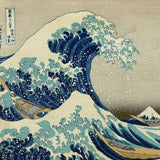
The print formally titled "Under the Wave off Kanagawa" (Kanagawa oki nami ura) appeared around 1831 as part of the series "Thirty-Six Views of Mount Fuji." The series was published by the Eijudo printing firm and ultimately comprised 46 prints in total — ten supplementary views were added to the original thirty-six in response to its popularity.
The print is physically small — approximately 25 × 37 cm in the original ōban format. Its global scale comes entirely from composition. The great wave arcs across the image, its foam claws reaching toward three fishing boats mid-crest. Mount Fuji, geometrically precise and snow-capped, sits in the lower right — small, calm, and distant. The composition reverses expected scale: the wave is enormous, Fuji is a thumbnail. That deliberate inversion is the visual argument of the image.
The color comes from Prussian blue — a synthetic pigment developed in Berlin around 1704 and imported into Japan via Dutch traders. The Metropolitan Museum's technical research has shown that printers used a double-printing method: first printing a mixture of Prussian blue and indigo for the deep outlines, then printing pure Prussian blue over the remaining areas. This layering creates an almost tactile depth — microscopic scanning reveals the ink layers sitting at different physical heights on the paper.
Debussy kept a print of The Great Wave in his studio. A 1910 photograph by Igor Stravinsky documents it on the wall behind his piano. When the score of La Mer was first published in 1905, Debussy chose a detail from The Great Wave for the cover — his name appearing in the calm sky above the wave. The Met has written about this connection in detail: it was deliberate homage, not coincidence.
Our print of The Great Wave of Kanagawa is sourced from high-resolution archive files of early impressions and printed on 225g fine art paper — the format closest to the original woodblock medium, where ink on washi paper was always the intended substrate.
Why Hokusai Prints Are Worth Collecting
Hokusai prints occupy a rare position in the art market: historically significant, visually accessible, and available as fine art reproductions across a wide price range. Four factors explain their enduring appeal.
Compositional Precision
Hokusai studied Dutch copperplate engravings and absorbed Western linear perspective into a Japanese visual tradition. The result is a body of work with unusual spatial depth — prints that read as more three-dimensional than their flat format suggests.
Cross-Cultural Influence
Monet owned 23 Hokusai prints. Van Gogh praised his line quality directly in letters to his brother Theo. Debussy put The Great Wave on his studio wall and on his score. This is documented influence at the highest level of Western art — not a marketing claim.
Depth of Catalogue
The Great Wave is the most reproduced image in the collection, but it's far from the most interesting. The waterfall series, the flower studies, the Manga volumes of figure drawings — Hokusai's output rewards attention beyond the iconic. The quieter works are often the best.
Public Domain Access
All of Hokusai's woodblock prints are in the public domain. Original early impressions sell at auction for sums in the millions. Fine art reproductions from high-resolution archive sources are the practical collector's route — and Hokusai was always explicit that his work was made for the broadest possible audience.
"From the age of six, I had a passion for copying the form of things… At seventy-three I began to understand the true construction of animals, plants, trees, birds, fishes and insects. At ninety I shall have cut my way deeper into the essence of all things."
— Katsushika Hokusai, colophon of One Hundred Views of Mount Fuji, 1834
Browse Hokusai Prints at Kuriosis →
Beyond the Wave — Waterfalls, Flowers, and the Manga
The Great Wave is not the entry point into Hokusai's work — it is the exit point for most casual viewers. The body of work surrounding it rewards considerably more attention.
The Illustrated Manual of the Waterfalls of Various Provinces (ca. 1833) is one of his most compositionally adventurous series. Each print depicts a different waterfall using a radically different structural approach — the Yoro Waterfall in Mino, the Amida Falls with their vertiginous cascade, the Ono Falls on the Kisokaidō road. Our print of The Amida Falls in the Far Reaches of the Kisokaidō Road exemplifies the series: the waterfall as a near-abstract vertical structure, human figures reduced to scale reference, the forest pressing in from both sides.
The Hokusai Manga — fifteen volumes of sketched figures, animals, plants, landscapes, and supernatural subjects, published from 1814 onward — were instructional manuals for amateur artists, not sketchbooks in the Western sense. Britannica describes them as "copybooks for amateur artists" containing thousands of individual drawings. When Japan opened to foreign trade in 1853, the Manga volumes were among the first Japanese printed works to reach European artists and collectors — and they landed with considerable impact.
Late in his life Hokusai began work on the One Hundred Poems Explained by the Nurse — a series illustrating classical waka poems from the 13th-century anthology Hyakunin Isshu. He was in his mid-seventies when he started it. Only 27 of the intended 100 prints were completed before his death; the Smithsonian and the Metropolitan Museum both hold examples. The Lilies by Katsushika Hokusai comes from this final period — his line at its most economical, his sense of composition undimmed.
More Hokusai prints from our collection:
Why Fine Art Prints? The Kuriosis Approach
Hokusai's prints were always made for wide distribution — woodblock printing was a commercial medium, and the Eijudo firm published the Thirty-Six Views in large edition runs specifically to reach the broadest possible audience. A fine art reproduction continues that intention: the image available to anyone who wants it on their wall, produced with materials that honour the original rather than diminish it.
At Kuriosis, we source high-resolution archive files of Hokusai's prints from major institutional collections, retouch color against early impression references, and print on 225g matte fine art paper using archival Japanese pigment inks. The paper format is deliberate — Hokusai's woodblock prints were designed for paper, not canvas, and fine art paper renders the ink layering and fine line detail more faithfully than canvas.
Every print is produced in our Berlin studio. No outsourcing, no drop-shipping. Framing options are oak, black, or brown hardwood with UV-protective glass. For Hokusai specifically, a slim black or natural oak frame suits the original aesthetic — clean lines that let the composition carry the room rather than the frame.
Sources & Further Reading
Browse All Hokusai Prints →

 Mount Fuji Red by Hokusai
 Yoro Waterfall by Hokusai
 The Amida Falls by Hokusai
 Lilies by Katsushika Hokusai
 Kannon Shrine at Kiyo Falls