Japanese art built on layered ink washes, atmospheric colour, and careful negative space — qualities that gain depth and warmth on canvas. This collection covers woodblock masters like Hasui and Hokusai, kimono textile patterns, and botanical studies from the Meiji and Edo periods.
Woodblock prints from the ukiyo-e and shin-hanga traditions were designed around layered colour — each tone applied as a separate impression from a carved block. On paper, these gradients appear flat and precise. On canvas, the texture of the weave softens transitions between colours and adds a tactile quality that suits the atmospheric nature of the work.
This is especially true for landscape prints by artists like Hasui Kawase, whose rain and snow scenes rely on subtle tonal shifts. The canvas surface picks up these gradations differently from paper, giving the image a warmth that feels closer to a painting than a reproduction.
Kimono textile patterns and botanical illustrations from the Meiji period also work well on canvas. The bold outlines and saturated colour fields of kimono designs gain visual weight on the textured surface, while botanical plates — often originally printed in muted earth tones — develop a richer, more organic feel.
Choosing Japanese canvas prints for your space
Japanese art tends to favour vertical compositions and generous negative space, which makes it well suited to narrow walls, hallways, and spaces between windows. A single Hasui landscape in 50×70 cm or 70×100 cm can anchor a room without overwhelming it.
For gallery wall arrangements, consider mixing formats: a large landscape print flanked by two smaller 30×40 cm portraits or botanical studies. The shared colour palette of Japanese art — muted blues, warm earth tones, soft greens — creates natural visual cohesion across multiple pieces.
If you prefer the crisp detail and sharp edges of the original woodblock technique, our Japanese art prints on paper preserve every line exactly as carved. Canvas is the better choice when you want the image to feel like a painting rather than a print.
Popular artists and styles
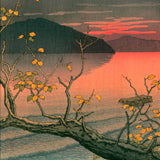
The collection includes shin-hanga landscapes by Hasui Kawase, known for his atmospheric depictions of temples, lakes, and seasonal weather. His snow scenes and rain-soaked street views are among the most popular Japanese canvas prints in the store.
You will also find ukiyo-e classics from the Edo period — wave scenes, kabuki figures, and nature studies by masters of the form. Alongside these, the collection includes Meiji-era textile designs drawn from kimono pattern books, with bold geometric motifs and natural dye colours that hold up well at larger canvas sizes.
For a broader selection that includes both paper and canvas formats, browse our Japandi collection or explore landscape prints across all styles.
From Edo-period ukiyo-e to the 20th-century shin-hanga revival — the history, technique, and collector's guide to Japanese woodblock prints. How they shaped Western art, what to look for when buying,...
Kawase Hasui (1883–1957) produced more than 600 woodblock print designs and became Japan’s first Living National Treasure printmaker. This collector’s guide covers his biography, the shin-hanga technique, what drives value...
A collector's guide to Katsushika Hokusai — the artist who changed his name thirty times, worked until his death at eighty-eight, and produced The Great Wave as one of 46...


 Road to Nikko by HasuiFrom CHF 19.00 /
 Morning Sea at Shiribeshi by HasuiFrom CHF 19.00 /
 Morning of Cape Inubo by HasuiFrom CHF 19.00 /
 Nenokuchi Lake by HasuiFrom CHF 19.00 /
 Red Cranes KimonoFrom CHF 19.00 /
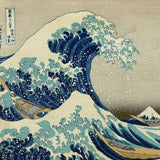
 The Great Wave of Kanagawa by HokusaiFrom CHF 19.00 /
 Mount Fuji from Lake Yamanaka by Takahashi ShōteiFrom CHF 19.00 /
 Autumn in OiraseFrom CHF 19.00 /
 Spring in Arashiyama by HasuiFrom CHF 19.00 /
 Lake Yamanaka and Mt. Fuji by HasuiFrom CHF 19.00 /
 Full Moon At Gamo Art Print by HasuiFrom CHF 19.00 /
 Samurai Frogs by Utagawa KuniyoshiFrom CHF 19.00 /
 Ioridani Pass, Etchu by HasuiFrom CHF 19.00 /
 7 Birds Japanese by KorinFrom CHF 19.00 /
 Joshu Hoshi Onsen by HasuiFrom CHF 19.00 /
 Green Peacock by KosonFrom CHF 19.00 /
 Geisha in the snow by HasuiFrom CHF 19.00 /
 Early Autumn in Urayasu Art Print by HasuiFrom CHF 19.00 /
 Shuzenji in Rain Art Print by HasuiFrom CHF 19.00 /
 Morning in the Beppu by HasuiFrom CHF 19.00 /
 Japanese Azaleas by Ogawa KazumasaFrom CHF 19.00 /
 Great Buddha at Kamakura by HasuiFrom CHF 19.00 /
 Tenno Temple, Osaka by HasuiFrom CHF 19.00 /
 Shimotsuke Waterfall by HokusaiFrom CHF 19.00 /
 Morning at Onegishi by HasuiFrom CHF 19.00 /
 Keegon Waterfalls at Nikko by HasuiFrom CHF 19.00 /
 Japanese Azaleas by Kazumasa ExhibitionFrom CHF 19.00 /
 Setting Sun, Ichinokura Art Print by KawaseFrom CHF 19.00 /
 Akisu Lake by HasuiFrom CHF 19.00 /
 Japanese flock of cranes by Ishida YūteiFrom CHF 19.00 /
 Mount Fuji Fujikawa by HasuiFrom CHF 19.00 /
 Japan at night by ShirôFrom CHF 19.00 /
 Yellow Lily by Kazumasa ExhibitionFrom CHF 19.00 /
 Hodakayama 1926 by Hiroshi YoshidaFrom CHF 19.00 /
 The Tiger of Ryokoku by HirokageFrom CHF 19.00 /
 Hachirōgata Lagoon, Akita Art Print By HasuiFrom CHF 19.00 /
 Fuji no Yukei by Utagawa KuniyoshiFrom CHF 19.00 /
 Mount Ashitaka by Takahashi ShōteiFrom CHF 19.00 /
 White Phoenix by Kamisaka SekkaFrom CHF 19.00 /
 Hansen gozen Sailing boats forenoon 1926 by Hiroshi YoshidaFrom CHF 19.00 /
 A Little Restaurant at Night by Hiroshi YoshidaFrom CHF 19.00 /
 Tsuruokahachimangu by HasuiFrom CHF 19.00 /
 The Zensetsu Temple in Sanshu by HasuiFrom CHF 19.00 /
 Nigatsudo Temple, Nara by HasuiFrom CHF 19.00 /
 Kamedonofuji Art Print by HasuiFrom CHF 19.00 /
 Chichibu In The Evening Art Print by HasuiFrom CHF 19.00 /
 Akita Tsuchizaki by HasuiFrom CHF 19.00 /
 Zaimoku Island in Matsushima by HasuiFrom CHF 19.00 /