What Makes George Barbier's Work Distinctive
George Barbier was one of the defining illustrators of the Art Deco era — a French artist whose fashion plates, theatre programmes, and pochoir prints captured the visual culture of 1920s Paris with unmatched elegance. He worked for the couturier Paul Poiret, illustrated editions of Baudelaire and Verlaine, and produced fashion plates for the Gazette du Bon Ton that remain benchmarks of decorative illustration.
Sortileges and La Belle Dame Sans Merci show Barbier's narrative illustration at its finest — theatrical compositions where every element serves both story and visual design. Costumes Parisiens captures Parisian fashion with the precision of a designer and the compositional confidence of a painter. Chez la Marchande de Pavots and Voici Mes Ailes move between the decorative and the fantastical, with flat colour fields, bold silhouettes, and ornamental borders drawn from Persian and Japanese sources.
What distinguishes Barbier from other illustrators of the period is the visual restraint. His understanding of luxury is rooted in economy — nothing is overdone, every element is deliberate. The pochoir printing technique — hand-applied colour through stencils — gives the original prints their characteristic flat, saturated colour, a quality that translates naturally to fine art reproduction.
Choosing the Right Format
Fine art paper is the natural choice for Barbier's pochoir-style illustrations. The flat colour fields, precise silhouettes, and fine decorative line work require a smooth matte surface where the graphic clarity of the original technique comes through without interference. Paper prints are available in A3, 50x70cm, 70x100cm, and A0, with oak, black, or walnut brown frames. Black frames suit the bold, graphic compositions; walnut brown adds period warmth.
Pairing George Barbier Prints
Three or four Barbier prints in matching frames create an elegant Art Deco gallery wall — the consistent visual language of flat colour, decorative borders, and elegant figures ties any combination together. Sortileges alongside Costumes Parisiens alongside Voici Mes Ailes, for instance, spans the theatrical, the fashionable, and the fantastical within a unified aesthetic.
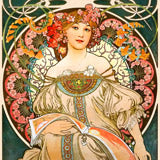
Barbier's Art Deco illustration pairs naturally with our vintage collection, where his 1920s elegance sits alongside other period design. For an Art Deco-themed wall, combine with prints from Alphonse Mucha, whose Art Nouveau illustration provides a visual prelude to Barbier's geometric refinement. The fashion illustration quality also connects to our design and illustration collection, and the decorative precision links to our Bauhaus collection, where the same era produced a radically different but equally deliberate design vocabulary.
All prints are produced in our Berlin studio using archival pigment inks rated for 100+ years.


 SortilègesFrom €23,99 EUR /
 Costumes ParisiensFrom €23,99 EUR /
 La Belle Dame Sans MerciFrom €23,99 EUR /
 Chez la Marchande de PavotsFrom €23,99 EUR /
 Voici Mes AilesFrom €23,99 EUR /
 La Fontaine de CoquillagesFrom €23,99 EUR /
 FuméeFrom €23,99 EUR /