What Makes Cezanne's Work Distinctive
Cezanne spent decades returning to the same subjects — Mont Sainte-Victoire, the card players of Aix-en-Provence, carefully arranged fruit on a tablecloth. He was not repeating himself. Each version was another attempt to solve the same problem: how to render three-dimensional solidity through colour alone, without relying on traditional perspective or Impressionist dissolution of form. The result is paintings that feel both solid and alive, constructed yet natural. His apples sit on tables that tilt impossibly, yet the composition holds. His mountain appears again and again, each time more abstracted, more reduced to its essential geometry. Picasso called him "the father of us all," and the geometric simplification visible in his later landscapes directly anticipates Cubism. His still lifes remain some of the most studied paintings in art history — not for their subjects, but for how they are built. Where the Impressionists captured a moment, Cezanne built something meant to last.
Choosing the Right Format
Cezanne's structured brushwork and layered colour planes translate well to both print formats. On fine art paper, available in A3, 50×70cm, 70×100cm, and A0, the subtle colour transitions and compositional geometry read with precision — particularly effective for his still life subjects where every tilted plane and colour shift matters. Frame options include oak, black, and walnut brown. Oak and walnut brown suit the warm Provençal palette of his landscapes, while black sharpens the more austere compositions like The Three Skulls. On canvas, in 30×40cm, 50×70cm, and 70×100cm, the textured surface adds a physical quality that echoes his painted surfaces — especially effective for his heavily worked landscape scenes. A floating frame gives canvas prints a gallery-level presentation. The Post-Impressionist collection includes more work from this period.
Pairing Cezanne Prints
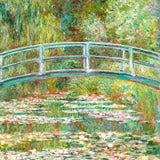
Cezanne pairs naturally with other Post-Impressionists who shared his interest in structure over atmosphere. Works by Vincent van Gogh bring complementary warmth and energy, while Henri Matisse — who studied Cezanne closely and owned one of his paintings — offers a more decorative counterpoint. For a quieter arrangement, his Provençal landscapes sit well alongside Claude Monet garden scenes, linking colour and light across two very different approaches to the same French countryside. His still lifes also pair effectively with other still life prints from across centuries, showing how the genre evolved from Dutch precision to modernist experimentation. Group similar colour palettes — the warm ochres and greens of his landscapes, or the cooler tones of his bather compositions — rather than mixing subjects randomly.
All prints are produced in our Berlin studio using archival pigment inks rated for 100+ years.


 Cézanne At the Water's Edge Art ExhibitionAb €23,99 EUR /
 The Three Skulls Art Exhibition By Paul CézanneAb €23,99 EUR /
 Still Life Art Exhibition By Paul CézanneAb €23,99 EUR /