Artist Spotlight · 10 min read · Kuriosis Studio Team, Berlin · April 2026
Hilma af Klint painted fully abstract work in 1906 — years before Kandinsky, Kupka, or Mondrian. She left instructions that her most important series not be exhibited until at least 20 years after her death. The paintings were not widely seen until the 1980s and did not reach a mass audience until the Guggenheim's 2018 retrospective drew more than 600,000 visitors and became the most-visited exhibition in that museum's history. This collector's guide covers the biography, the major series, the debate over abstraction's origins, and how to choose the right af Klint print for a wall.
The Swedish Painter Who Predated the Abstract Canon
Hilma af Klint was born on 26 October 1862 at Karlberg Palace in Solna, near Stockholm — the fourth of five children of naval officer Fredrik Victor af Klint. She trained at the Royal Academy of Fine Arts in Stockholm from 1882 to 1887 and graduated with honours. Sweden admitted women to its fine-art academies earlier than France, Germany, or Italy, placing af Klint in an early cohort of formally trained women painters. Her teachers included Georg von Rosen and August Malmström; her training focused on portraiture, botanical drawing, and landscape.
Before she turned to abstraction she worked as a botanical illustrator — a background that shaped the precision visible in her later work. In 1896 she co-founded a spiritualist group called The Five (De Fem) with four other women: Anna Cassel, Cornelia Cederberg, Sigrid Hedman, and Mathilda Nilsson. They met weekly for a decade, conducting séances, practising automatic drawing, and claiming contact with a set of spirit guides they called "De Höga" — The High Masters. According to the Hilma af Klint Foundation, it was through this practice that she began the work that would define her legacy.
The Paintings for the Temple
Between November 1906 and March 1907, af Klint painted a 26-work series called Primordial Chaos. These were fully non-objective paintings, with no representational subject. This places her work at least four years before Kandinsky's conventionally dated First Abstract Watercolour of 1910, and roughly five years before his first fully abstract oils. She described the commission as coming via a spirit guide named Amaliel, who instructed her to paint what she called "The Paintings for the Temple."
The full Paintings for the Temple cycle ran from 1906 to 1915 and comprises 193 works across multiple subseries. The best-known is The Ten Largest (1907) — ten monumental paintings, each roughly 328 by 240 centimetres, depicting what she called the four ages of human life: Childhood, Youth, Adulthood, and Old Age. Other subseries include The Seven-Pointed Star (1908), The Swan (1914–15), The Dove (1915), and a final set of three Altarpieces (1915) — pyramid and triangle compositions that close the cycle.
Af Klint met Rudolf Steiner in 1908. According to several accounts he was unenthusiastic about the work and told her it should not be shown for at least 50 years. She accepted the core of the advice. In 1932 she marked her notebooks with an X and left instructions that The Paintings for the Temple not be publicly exhibited until at least 20 years after her death. She died in Djursholm on 21 October 1944 following injuries from a streetcar accident. She was 81.
The Long Posthumous Reappraisal
Af Klint's abstract work was not widely exhibited during her lifetime. After her death the canvases stayed with her nephew Erik af Klint, who eventually established the foundation that still manages her estate. The first major public exhibition of her abstract work came in 1986, when curator Maurice Tuchman included her in The Spiritual in Art: Abstract Painting 1890–1985 at the Los Angeles County Museum of Art. That show ran from November 1986 to March 1987 and travelled to Chicago and The Hague. It was the first time a substantial international audience saw her painting.
The reappraisal accelerated steadily from there. Writing for Tate Etc. in 2013, Julia Voss argued that af Klint preceded Kandinsky by roughly five years and that the traditional narrative of abstraction's origins required revision. The claim is still contested — Kupka, Malevich, and Mondrian have their own advocates, and some argue the category "first abstract painter" is itself unstable — but the evidence for af Klint's 1906 date is solid enough that most serious accounts of abstraction's origins now mention her.
Then came the Guggenheim exhibition. Hilma af Klint: Paintings for the Future ran from 12 October 2018 to 23 April 2019, curated by Tracey Bashkoff. According to the Guggenheim's own press release, the show drew more than 600,000 visitors — the most-visited exhibition in the museum's 60-year history. Museum membership increased 34 percent during the run, and the exhibition catalogue sold more than 30,000 copies, surpassing the record previously held by the 2009 Kandinsky catalogue.
What Drives Hilma af Klint's Collector Value
Historical Primacy
Primordial Chaos (1906–07) predates Kandinsky's first abstract watercolour by roughly four years. Her work forces a rewrite of the abstract canon — one of the most significant art-historical reappraisals of the last forty years.
Exhibition Record
The 2018–19 Guggenheim retrospective drew 600,000+ visitors — the most-visited exhibition in the museum's 60-year history. A 34% membership increase during the run. Her catalogue outsold Kandinsky's.
Closed Estate
The Hilma af Klint Foundation holds most of her 1,200+ works. Originals almost never come to market — a structural scarcity that shapes how her work is valued. Prints are the primary way collectors encounter the full series.
Visual Resonance
The palette — blues, pinks, yellows, warm greens — and the symbolic vocabulary of dual spirals and ovoid forms read as strikingly contemporary. Af Klint's work looks current in a way most early-twentieth-century abstraction does not.
"Paintings for the Future became the most-visited exhibition in the Solomon R. Guggenheim Museum's 60-year history, drawing more than 600,000 visitors."
— Solomon R. Guggenheim Museum press release, April 2019
Browse Hilma af Klint Prints at Kuriosis →
Choosing the Right Af Klint Print for Your Room
Af Klint's paintings were designed at scale. The Ten Largest measures more than three metres tall — the originals were meant to be read from across a room. A print at A3 can feel cramped; at A0 or 70×100cm, the radial symmetry and colour transitions start to do what she intended. If you have the wall for it, go as large as the space supports.
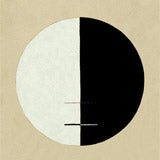
The flat colour fields and geometric precision of her work — particularly Buddha's Standpoint and the geometric studies — reproduce with sharp clarity on fine art paper. Oak frames complement her warm palette without competing for attention. Black frames work well with the more structured, geometric compositions. On canvas, the surface texture adds warmth to the softer transitions between colour areas, particularly in the works where af Klint layers translucent washes over one another — Altarpiece No. 1 is a good example of a piece that gains depth on canvas.
For pairing, a diptych from The Ten Largest — Nr 1 and Nr 2, for instance — creates a strong focal point in a living room or hallway. Mixing works from different series also works: the geometric rigour of Buddha's Standpoint sits comfortably alongside the flowing forms of the earlier paintings. Give these compositions space on the wall. They were designed large and read best when not crowded.
More Hilma af Klint prints from our collection:
Why Fine Art Prints? The Kuriosis Approach
Every Hilma af Klint print we sell is produced in our Berlin studio using archival pigment inks rated for a hundred years of colour stability. Her palette — the soft pinks, blues, and yellows — is particularly demanding; we calibrate against museum reproductions to keep the colour relationships intact.
Sources & Further Reading
- Hilma af Klint Foundation — Biography
- Moderna Museet Stockholm — Hilma af Klint biography
- Guggenheim Museum — Paintings for the Future, most-visited exhibition press release
- Tate Etc. — Julia Voss: The first abstract artist (and it's not Kandinsky)
- Wikipedia — Hilma af Klint
- Guggenheim teaching materials — Paintings for the Temple
The Ten Largest Nr 1
The Ten Largest Nr 3
Buddha's Standpoint
Altarpiece Nr 1
The Dove