Artist Spotlight · 8 min read · Kuriosis Studio Team, Berlin · July 2026
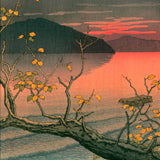
Hiroshi Yoshida came to the woodblock late, and from an unexpected direction. He had already made his name as a Western-style oil and watercolour painter, shown in American and European museums, before he ever cut a block. When he did turn to printmaking in his forties, he brought all of that with him — perspective, atmosphere, the fall of real light — and fused it with a centuries-old Japanese craft. The result is a body of work that sits between two worlds, and one of the most quietly rewarding names a print collector can start with. The evening scene at the top of this page, his view of the Kiso River, is a fair introduction: a Japanese woodblock print that behaves like a landscape painting, with a real sun going down over real water.
Hiroshi Yoshida is one of the masters featured in our complete guide to Japanese wall art — the styles, the masters, and how to choose a print for your home.
From oil painter to woodblock master
Yoshida was born in 1876 in Kurume and adopted at fifteen by the art teacher Kasaburō Yoshida, whose name he took. He trained first as a yōga (Western-style) painter, and recognition came early and internationally: according to biographical records, he exhibited at the Detroit Museum of Art in 1899, at the 1900 Paris Exposition, and won a bronze medal at the 1904 St. Louis World's Fair — all as a painter. The Art Institute of Chicago describes him as "one of the most prolific artists in the history of woodblock printing," with landscapes "coveted by collectors in Japan and abroad."
He presented his first woodcut at the workshop of publisher Watanabe Shōzaburō around 1920, at the age of 44. It was a short collaboration. The Great Kantō earthquake of 1 September 1923 destroyed Watanabe's shop and its blocks, and in 1925 Yoshida took a decisive step: he hired his own carvers and printers and set up a studio under his own close supervision. Prints made this way carry his jizuri (自摺, "self-printed") seal — and that little mark still matters to collectors today.
That decision is the key to understanding him. Most ukiyo-e was a business run by the publisher, who commissioned the design, financed the blocks and could cancel an unprofitable run. By taking the workshop in-house, Yoshida made the print answer to the artist instead of the market. He could push his printers for more passes, more subtle gradations and colour choices that a commercial publisher might have refused as too slow or too costly. It is why his sheets carry an unusually high number of impressions and a depth of tone that is hard to find elsewhere in the period.
Shin-hanga: new prints from an old craft
Yoshida worked in the shin-hanga ("new prints") movement, the early-twentieth-century revival led by Watanabe that set traditional woodblock craft against the rising age of photography. The Smithsonian National Museum of Asian Art holds a deep collection of his work and frames him squarely within it. A woodblock print in this tradition is a four-way collaboration — publisher, designer, block carver and printer — with a separate block cut for each colour. What set Yoshida apart is that he oversaw the whole chain himself.
His signature move was to print a single set of blocks in different colour combinations to capture different times of day and weather. His 1926 Sailing Boats exists as a whole arc of variants — morning, forenoon, afternoon, mist, evening, night — the same harbour remade by light alone. The Smithsonian's records confirm the extensive hand-applied bokashi gradations behind those atmospheric skies. It is a painter's instinct, executed through a printmaker's discipline.
The craft behind that effect is worth understanding, because it is what you are really buying. Each colour needs its own carved block, aligned to the others by small registration marks so the layers land exactly in place. A gradient sky is not a printed colour but a wiping technique: the printer loads the block unevenly and pulls the tone by hand, pass after pass, and no two impressions are ever quite identical. A single Yoshida sheet could take dozens of separate printings. When you look at one of his evening skies, you are looking at a record of that patient, additive labour — the reason a good impression rewards close viewing that a poster reproduction never will.
 Summit of Mount Fuji (1928)
 Sailing Boats, Forenoon (1926)
 Snow at Kashiwabara
A painter's eye for light and distance
Because he came from oil painting, Yoshida handled space differently from the classic ukiyo-e masters. His mountains recede with real atmospheric perspective; his water holds reflections; his snow scenes feel cold. The Japan Foundation's exhibition Carving Across Borders centres exactly this — his bridging of Western realism with the traditional medium. A mountaineer himself, he returned again and again to the Japanese Alps and to Mount Fuji, as in his 1928 Summit of Mount Fuji.
His curiosity also travelled. Over the winter of 1930–31 he journeyed through India and Southeast Asia with his son Tōshi, and the trip produced a series of prints of temples, cities and light unlike anything else in Japanese printmaking of the period — the glowing Golden Pagoda in Rangoon among them. Where earlier ukiyo-e travel scenes stayed close to home, Yoshida carried the Japanese woodblock abroad and used it to record a temple at dusk in Rangoon or a carved window in Fatehpur-Sikri, applying the same graded skies to foreign light. (A note for new collectors: Hiroshi is not to be confused with his son Tōshi Yoshida, 1911–1995, also an accomplished printmaker; the two travelled together and both used the family name.)
That blend of Western observation and Japanese craft is also why his reputation has held so steadily. He was celebrated in his own lifetime on both sides of the Pacific, and his landscapes have never gone out of favour with collectors — the Art Institute of Chicago's decision to build a full "Yoshida Family: Three Generations" exhibition around him and his descendants is a measure of how firmly he sits in the story of modern printmaking. For a first serious print, he offers something rare: museum-level standing, a large and varied body of work to choose from, and images that are genuinely calming to live with.
What drives collector value
Yoshida is one of the most approachable shin-hanga artists to begin collecting, but a few things separate a fine impression from an ordinary one.
The jizuri seal
His "self-printed" margin seal marks impressions made under his own supervision — the detail collectors look for first.
Early impressions
Lifetime printings best carry his intended colour; worn later blocks lose the fine gradation.
Condition
Fugitive colours fade with light and trimmed margins reduce value — original works are kept out of direct sun.
Subject & series
Fuji, the Alps and the Inland Sea sailing boats are his most sought-after subjects.
"One of the most prolific artists in the history of woodblock printing."
— Art Institute of Chicago, on Hiroshi Yoshida
Browse Hiroshi Yoshida Prints at Kuriosis →
Living with a Yoshida print
Yoshida's work is easy to live with because it was built around light. A soft evening scene like the Kiso River or the lantern-lit A Little Restaurant at Night settles a room down — good over a bed, a reading chair, or a dining wall where the light is already warm. His brighter daytime landscapes, like the Fuji summit or the cherry blossoms at Arashiyama, hold their own in a busier, sunlit space. Because so many of his prints share a horizontal format and a common palette of blues, greys and soft pinks, two or three hung together read as a calm, cohesive set rather than a clash.
More Hiroshi Yoshida prints from our collection:
 Cherry Blossom at Arashiyama (1935)
 Golden Pagoda in Rangoon (1931)
 A Little Restaurant at Night
Why Fine Art Prints? The Kuriosis Approach
We produce every print in our own Berlin studio with archival pigment inks, so the graded skies and soft colour that define Yoshida's work hold true on the wall rather than fading. Browse the full Yoshida collection to find the scene that fits your room.
Sources & Further Reading
- Wikipedia — Hiroshi Yoshida (biography and chronology)
- Art Institute of Chicago — Yoshida Hiroshi
- Smithsonian National Museum of Asian Art — Japan Modern: Prints in the Age of Photography
- The British Museum — Yoshida Hiroshi (biography record)
- Japan Foundation — Carving Across Borders: Block Prints of Hiroshi Yoshida