Art History · 8 min read · Kuriosis Studio Team, Berlin · April 2026
Few artistic traditions have crossed as many borders — cultural, stylistic, geographical — as Japanese woodblock prints. Born in the merchant culture of Edo-period Japan, refined by masters like Hokusai and Hiroshige, and revived in the 20th century by a generation of shin-hanga artists, these prints shaped Impressionism, sparked Art Nouveau, and today remain among the most sought-after decorative artworks in the world. This guide covers the history, the technique, and what to look for when collecting.
Ukiyo-e — Pictures of the Floating World
The word ukiyo-e (浮世絵) translates literally as "pictures of the floating world." It was not, at first, a term of reverence. Edo Japan's Tokugawa shogunate ranked merchants at the bottom of its official social hierarchy, below samurai, farmers, and artisans. But merchants accumulated wealth, and they spent it on art that reflected their world: the pleasure districts, the kabuki theatres, the landscapes seen from the great road networks that connected Japan's cities. Ukiyo-e was popular art — woodblock prints sold cheaply, printed in large editions, hung in homes not galleries.
The technical foundations were established by the 1760s, when Suzuki Harunobu pioneered full-colour polychrome printing — known as nishiki-e, or brocade pictures. Complex compositions now required ten or more separate woodblocks, each carrying a single colour. The resulting prints had a chromatic richness that woodcut traditions elsewhere in the world couldn't match.
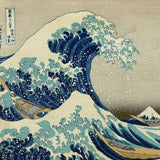
The 19th century produced the giants. Katsushika Hokusai (1760–1849) created "The Great Wave off Kanagawa" around 1831 as part of his series Thirty-six Views of Mount Fuji — a work that used Prussian blue, a recently imported Western pigment, to achieve its distinctive cold palette. Utagawa Hiroshige (1797–1858) followed with landscape travel series — The Fifty-three Stations of the Tōkaidō (1833–34), One Hundred Famous Views of Edo (1856–59) — that pioneered bokashi (colour gradation) and the use of oversized foreground objects to create depth.
By the late 19th century, Western demand for original prints had grown large enough to drive prices beyond most collectors' reach. French dealer Tadamasa Hayashi exported large quantities to Paris, where Japanese art sparked an aesthetic revolution that would take the name Japonisme — and change the course of European painting.
The Craft: How a Japanese Woodblock Print Is Made
The traditional woodblock process required four separate specialists: artist, carver, printer, and publisher. Each played a distinct role, and the quality of a print depended on all four working at their best.
The artist's design was drawn on thin washi (Japanese paper), then glued face-down onto a plank of smooth cherry wood. Carvers cut away the wood around the design to produce the key block — the outline block, called the omohan — which was printed first in black to establish all contours. From this master impression, separate blocks were carved for each colour.
Colour registration across ten or more blocks was achieved through kento marks — two small registration guides (an L-shaped corner mark and a straight edge) carved into every block in identical positions. These ensured each colour layer aligned precisely, print after print. The inks used were water-based rather than oil-based, which is why great Japanese prints have a luminous, translucent quality that Western woodcut tradition — which used oil inks — never achieved.
Paper was pressed against the inked block using a baren — a flat, hand-held tool with a bamboo-leaf core and coiled bamboo-leaf cover — giving printers direct tactile control over ink transfer. No mechanical press. The baren is why original prints vary subtly between impressions: the printer's touch was part of the work.
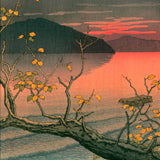
A finished polychrome print by Hiroshige or Hokusai typically used between 10 and 20 separate woodblocks. Our print of Nenokuchi Lake by Hasui exemplifies the results of this process at its 20th-century peak — quiet water, atmospheric mist, and colour gradations that no digital process fully replicates but that fine art paper reproduction comes closest to capturing.
 Geisha in the Snow by Hasui
 Mount Fuji from Lake Yamanaka by Takahashi Shōtei
What Makes Japanese Prints Collectible — Four Factors
The market for Japanese woodblock prints spans everything from affordable reproductions to originals selling for six figures at auction. Four factors determine where on that spectrum a particular work sits — and understanding them helps you collect with intention rather than guesswork.
Artist Reputation
Hokusai, Hiroshige, Hasui, and Koson command the highest prices at auction. Beyond the famous names, lesser-known artists in the same movements — Takahashi Shōtei, Ogawa Kazumasa, Kono Bairei — often offer equivalent quality at a fraction of the price.
Subject Matter
Snow scenes, Mount Fuji, and atmospheric night landscapes drive the highest collector demand. Bird-and-flower prints (kachō-e), figures in landscapes, and harbour scenes follow close behind. Abstract or commercial subjects from the same period tend to price lower.
Movement and Period
Ukiyo-e originals from the Edo period are museum territory. Shin-hanga prints from 1915–1942 are the serious collector's sweet spot — made with the full traditional technique, deliberately produced for international taste. Sōsaku-hanga (artist-made) prints from the 1950s onwards represent a separate collecting category.
Reproduction Quality
For most buyers, the practical question is reproduction quality. Archival inks on cotton canvas or matte fine art paper capture the colour gradations and surface depth of the originals far better than commercial poster printing. The substrate matters as much as the source file.
"Van Gogh painted oil copies of Hiroshige and Eisen prints as direct study exercises. Monet modelled his Giverny garden on Japanese design principles and collected ukiyo-e throughout his life."
— From the history of Japonisme
Browse Japanese Art Prints at Kuriosis →
Shin-hanga — The 20th-Century Revival
By 1900, ukiyo-e production had largely collapsed. Mass printing had eroded the market; the Meiji government's modernisation drive treated traditional crafts as relics. It took one publisher to change this. Watanabe Shōzaburō (1885–1962) founded the shin-hanga (new prints) movement deliberately, recruiting artists trained in Western painting techniques and commissioning prints that combined traditional woodblock craft with a new visual sensibility shaped by Impressionism.
The movement retained the traditional division of labour — artist, carver, printer, publisher — but added something new: a conscious attention to atmosphere. Light on water at dusk. Snow falling in a temple courtyard. Mist over a mountain road. These subjects, which ukiyo-e had treated descriptively, became in shin-hanga almost meditative — works designed to create a mood rather than document a scene.
Kawase Hasui (1883–1957) became the movement's most celebrated landscape artist, producing approximately 620–1,000 prints across four decades. He trained in Western-style painting before committing to woodblock, which gave his work its distinctively modern quality: naturalistic light, atmospheric depth, and compositional restraint. In 1956 — one year before his death — the Japanese government named him a Living National Treasure, the highest cultural recognition in Japan.
Other shin-hanga masters worth knowing: Ohara Koson (1877–1945), who specialized in kachō-e (bird-and-flower prints) and whose works are held by the British Museum, the Brooklyn Museum, and the Rijksmuseum; and Takahashi Shōtei (Hiroaki), known for light-filled landscapes that bring Western tonalism to Japanese subjects. Our Red Cranes Kimono print captures the boldness of Japanese decorative tradition — vivid pattern, stark composition — that made shin-hanga so appealing to Western collectors from the movement's first export shows in Boston and Indianapolis in the 1920s.
The movement slowed after World War II and never fully recovered its original scale. That scarcity is part of what drives collector interest today — and what makes fine art reproductions of these works the most practical way to live with them.
More Japanese art prints from our collection:
 Morning Sea at Shiribeshi by Hasui
 Morning of Cape Inubo by Hasui
 Joshu Hoshi Onsen by Hasui
Why Fine Art Prints? The Kuriosis Approach
Original shin-hanga prints by Hasui and his contemporaries now sell for thousands of euros at specialist auctions. For most collectors, fine art reproductions are the practical answer — but quality varies enormously, and the gap between a well-made reproduction and a cheap poster is immediately visible.
The critical factors are source file quality and print substrate. Water-based inks on washi paper give Japanese woodblock prints their luminous, layered look — a quality that matte fine art paper reproduces more faithfully than glossy photo paper or standard poster stock. At Kuriosis, we source high-resolution archive files, retouch them against original references where available, and print on 400g cotton fine art paper using archival Japanese pigment inks stable for 100+ years.
Every print is produced in our Berlin studio — no outsourcing, no drop-shipping. Canvas prints use our floating frame system with a 5mm shadow gap. Framed paper prints use UV-protective glass in oak, black, or brown hardwood. The production chain starts and ends with us, which means we control the result at every step.
Japanese art prints work across a wide range of room settings. Snow scenes and atmospheric landscapes suit bedrooms and reading spaces. Bold bird-and-flower prints hold their own as single focal pieces in living rooms. The consistent visual grammar of shin-hanga — controlled palette, clear composition, atmospheric depth — means pieces from different artists in the collection read as a coherent set rather than a random assembly.
Sources & Further Reading
- Wikipedia — Ukiyo-e: origins, technique, key artists, and Western influence
- Wikipedia — Shin-hanga: movement timeline, Watanabe Shōzaburō, and key artists
- Wikipedia — Japonisme: Van Gogh, Monet, Klimt, and the European reception of Japanese art
- Wikipedia — Woodblock Printing in Japan: kento marks, baren, washi, and water-based ink technique
- Metropolitan Museum of Art — Hokusai, Under the Wave off Kanagawa: provenance and technical notes