Artist Spotlight · 8 min read · Kuriosis Studio Team, Berlin · April 2026
Few artists captured the mood of a snowy Japanese evening — or a coastal morning, a rain-soaked temple street, a moonlit harbor — as precisely as Kawase Hasui. Born in Tokyo in 1883, Hasui produced more than 600 woodblock print designs over four decades, and today his work remains one of the most consistently collected categories in Japanese art. This guide covers who he was, how he worked, why his prints endure, and what to look for if you want to bring one into your home.
Kawase Hasui is one of the masters featured in our complete guide to Japanese wall art — the styles, the masters, and how to choose a print for your home.
From Rope Merchant's Son to Living National Treasure
Hasui was born on May 18, 1883, in the Shiba district of Tokyo, the son of a family running a rope and thread business. The business collapsed when he was 26 — which, while financially ruinous, freed him from a career he had little interest in. He had already been studying Western-style oil painting under Saburosuke Okada, and he now committed fully to art, moving on to train in nihonga (traditional Japanese painting) under the master Kiyokata Kaburagi. Kaburagi initially dismissed him as too old a student; he eventually recognized his talent and gave him the name "Hasui" — meaning water gushing from a spring.
His first woodblock print designs were published in August 1918 through the publisher Shozaburo Watanabe, whose S. Watanabe Color Print Co. became the engine behind the entire shin-hanga movement. The partnership lasted nearly 40 years and produced over 600 designs — what we now call the canonical Hasui: atmospheric landscapes of snow, rain, moonlit streets, and quiet coastal views from all across Japan.
The Great Kanto Earthquake of September 1923 interrupted everything. Watanabe's workshop burned to the ground. Hasui lost his home, 188 sketchbooks, and all woodblocks that were in production at the time. Pre-earthquake impressions — already out in the world with individual collectors — survived by chance, and their rarity today is permanent: most were sold before the fire consumed the workshop stock. In the months after the earthquake, rather than stopping work, Hasui embarked on the longest sketching journey of his career — 102 days through the Hokuriku, San'in, and San'yo regions — filling new sketchbooks that became the basis for his most celebrated later works.
He was designated a Living National Treasure (Ningen Kokuho) in 1956, the first woodblock print artist in Japanese history to receive this honor. The recognition came with an unusual dimension: because shin-hanga required the collaboration of designer, carver, and printer, the government also formally documented the complete production process of the commemorative print "Snow at Zojoji" — acknowledging that all three roles were essential to the art. Hasui died on November 7, 1957, while hospitalized with cancer. His final print, depicting the Hall of the Golden Hue at Hiraizumi, was completed from his hospital bed. Watanabe distributed copies at the memorial service in March 1958.
Shin-hanga: A New Print for a New Century
To understand what distinguishes a Hasui print from earlier Japanese woodblock art, you need to understand shin-hanga — the "new prints" movement he helped define. Shin-hanga emerged in the early twentieth century as a deliberate reinvention of the classical ukiyo-e tradition: keeping the collaborative woodblock technique, but introducing Western ideas of individual emotional expression, atmospheric light, and mood that traditional ukiyo-e had mostly avoided. The result was a body of work that looked entirely Japanese but carried an emotional directness that resonated strongly with Western collectors from the 1920s onward.
The production process itself has not changed in centuries. A designer draws the composition. Professional carvers cut the design into cherry wood blocks in relief — typically 10 to 15 separate blocks for a polychrome print, one per color layer. Printers apply water-based pigments and press mulberry paper against each block in sequence, using registration cuts on the block's edge to keep colors aligned across the layers. As documented by the Metropolitan Museum of Art, in Watanabe's workshop these roles were strictly divided: Hasui designed, Watanabe's specialist carvers cut, and master printers executed the final impression. Hasui supervised production but did not carve or print himself.
What makes this technically interesting is how much of the final image's light and texture was the printer's achievement. The soft gradients in a Hasui sky, the way snow diffuses the glow of a lantern, the delicate layering that gives depth to a rain-soaked street — these are the printer's interpretation of Hasui's color notations on a sketch. When collectors pay a premium for a first-impression over a later reprint, they are partly paying for the skill of that specific printer at that specific moment, which cannot be recovered after the fact.
Hasui's signature subjects — snow-covered villages, rainy evenings, moonlit ports, coastal mornings — were chosen precisely because they made the greatest atmospheric demands on the printing process. His first falling-snow design, introduced in 1920, required Watanabe's printers to solve the problem of white on white: how do you show depth and movement in snow without outlining it? The solutions developed across dozens of snow-scene designs — among them his iconic Geisha in the Snow — became one of the most technically refined bodies of work in the entire shin-hanga catalog.
He was also a tireless traveler. Severely nearsighted and reliant on thick glasses for close-up detail work, Hasui would sketch on-location across Japan, recording the quality of light on a harbor at dawn or the specific angle of snowfall in a mountain village, then complete the designs with color notations back in his lodgings. His "Souvenirs of Travel" series — three volumes published between 1919 and 1929, covering regional landscapes across Japan — elevated what had traditionally been a tourist-sketchbook format into single-sheet fine art prints and established his early reputation.
 Road to Nikko by Hasui
 Geisha in the Snow by Hasui
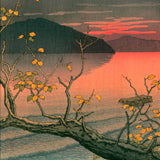
 Nenokuchi Lake by Hasui
What Collectors Look For — and What Drives Value
The Smithsonian's National Museum of Asian Art holds one of the two largest Hasui collections in the world — the Robert O. Muller bequest of several thousand prints, donated in 2003 and considered the premier shin-hanga collection globally. The other is the Watanabe family collection. That two institutions hold that volume of a single artist's work tells you something about how seriously Hasui is taken at the scholarly and curatorial level. His prints have appeared in Sotheby's and Christie's auctions for decades, and the market shows sustained price growth across all tiers.
Current market price ranges, based on Artelino's auction database of 2,000+ Hasui records and Sotheby's Japanese prints results:
| Edition Type | Typical Condition | Price Range (EUR) |
|---|---|---|
| Posthumous Heisei reprints (post-1957) | Variable | Under €300 |
| Pre-war Showa editions, good condition | Good | €1,400 – €2,800 |
| Taisho-era lifetime impressions (1912–1926) | Excellent | €5,000 – €10,000 |
| Pre-1923 impressions, snow/night subjects | Excellent | €30,000 – €100,000+ |
The top tier reaches well beyond these figures: his "Zojoji Temple in Shiba" snow scene sold for £31,200 (approx. €36,500) at Sotheby's London in November 2024, and the overall Hasui auction record — "Tenno-ji Temple in Osaka" — achieved $109,100 (approx. €98,000) at Sotheby's in 2024. These exceptional results reflect first-impression pre-earthquake designs of iconic subjects; the broader market for Taisho-era prints remains far more accessible.
Four factors drive these differences:
Edition Status
Watanabe's publisher seals changed across periods. The pre-1923 rectangular seal marks the most desirable era. When the earthquake destroyed the workshop in September 1923, it also destroyed most unsold stock — so surviving pre-earthquake impressions exist only as copies already sold to collectors before the fire. Permanent, documented scarcity.
Condition
Unfaded colors, clean margins, no foxing (brown spotting from moisture), no repairs. Hasui's characteristic deep indigos and pale snow-whites are water-based pigments on mulberry paper — materials that respond visibly to light and humidity. A print with "strong, unfaded colors" after 100 years commands a genuine premium.
Subject Matter
Snow scenes, rain scenes, and night views consistently outperform other subjects. Kyoto and rural subjects outperform urban scenes. A falling-snow composition with a solitary figure — Hasui's personal signature format — demands more from the printer, and that skill is visible in the finished work.
Rarity of the Design
Some designs survive in hundreds of impressions; others in only a handful. Edition sizes were never documented, but auction frequency gives a practical guide. His catalog of 600+ designs contains dozens of less-famous works more accessible at entry price points — equally characteristic of his style.
"A masterpiece within Hasui's oeuvre, and no other by him has received so much praise."
— Narazaki Muneshige, first Hasui catalogue raisonné (1979), on the Zojoji snow scene
Browse Hasui Kawase Prints at Kuriosis →
Hanging a Hasui Print: Practical Notes
The standard oban print format Hasui used — roughly 36 × 24 cm, or 14 × 9.5 inches — is modest by Western standards. These were prints made for private homes, not exhibition walls, and they carry that intimacy with them. Vertical compositions (a snow scene with a single figure, a temple gate in a blizzard, a lantern-lit street) work well in narrower spaces: a hallway, a reading corner, above a desk or bed. Horizontal compositions — harbor mornings like Morning Sea at Shiribeshi or Morning of Cape Inubo, panoramic coastlines, wide mountain views — work in wider formats across a living room or dining room wall.
Hasui's palette is cool-leaning: deep blue-grey skies, pale blue snow, cream and ochre in his warmer landscapes. His prints pair well with natural materials — pale wood, linen, stone, matte plaster — and sit uncomfortably next to saturated warm colors or high-gloss surfaces. The understatement is the point: his prints are designed to reward sustained attention in a domestic setting, not to announce themselves from across a room.
One observation worth noting: because Hasui's prints are mood-based rather than narrative — light, weather, season are the subject, not events or people — they change in character with the season and time of day. The same print looks different on a grey November morning than in summer light. That responsiveness was intentional. Hasui designed landscapes for homes, and it shows in how they live over time.
More Hasui prints from our collection:
 Morning of Cape Inubo
 Joshu Hoshi Onsen
Why Fine Art Prints? The Kuriosis Approach
At our Berlin studio, we produce all Hasui prints in-house using archival pigment inks on either fine art matte paper or 400g cotton canvas, depending on the format chosen. Every file is processed at the resolution needed to hold Hasui's delicate gradients — the soft atmospheric transitions between sky and snow, the layered depth that gives his night scenes their quality — without banding or posterization. We started in 2015 printing on Berlin art markets, and gallery-quality output at honest prices has been the trade since the beginning.
Our Hasui collection covers 56 designs, from well-known works like Geisha in the Snow to quieter pieces like Nenokuchi Lake and Road to Nikko — landscapes that are less frequently reproduced and benefit from the fidelity of fine art printing. Available as unframed paper prints, framed prints with oak or black frames, or canvas with floating frames. All produced on demand in Berlin.
Sources & Further Reading
- Metropolitan Museum of Art — Kawase Hasui, The Temple Zojoji in Shiba (1925): collection record with production context and shin-hanga movement overview
- Smithsonian National Museum of Asian Art — Robert O. Muller Collection: Tsuta Marsh, Mutsu (1919), from the Souvenirs of Travels series
- Wikipedia — Kawase Hasui: full biography, career timeline, Living National Treasure designation, and complete works context
- Artelino — Kawase Hasui biography, shin-hanga context, and collector market analysis
- Artelino — Kawase Hasui auction database and price reference (2,000+ records)