Oskar Schlemmer — Bauhaus Pioneer and Master of Form
Oskar Schlemmer (1888–1943) was one of the defining figures of the Bauhaus movement. Born in Stuttgart, he studied at the city's Academy of Fine Arts before joining the Bauhaus in Weimar in 1921, where he led the sculpture workshop and later the stage workshop. Schlemmer's paintings reduce the human figure to geometric essentials — cylinders, spheres, cones, and flat planes — creating a visual language where the body becomes a form of architecture. His figures inhabit shallow, stage-like spaces, stripped of individual identity yet charged with a quiet, monumental presence.
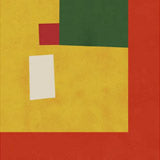
His 1922 Triadic Ballet remains one of the most radical fusions of visual art and performance from the twentieth century. Dancers moved in padded geometric costumes that turned the human body into sculpture, anticipating performance art by decades. Schlemmer's Bauhaus exhibition posters, with their bold graphic simplicity and structural precision, are among the most recognisable images of the movement. After the Nazis closed the Bauhaus, Schlemmer was branded a degenerate artist and spent his final years in relative obscurity.
Oskar Schlemmer Prints — Produced in Berlin
At Kuriosis, we produce Oskar Schlemmer's iconic Bauhaus works as fine art prints and canvas prints in our own Berlin studio. Fine art paper prints use 225g matte stock, delivering the sharp graphic lines and bold flat colour fields of Schlemmer's poster designs with archival precision. Available in A3, 50×70 cm, 70×100 cm, and A0. Canvas prints on 400g cotton in 30×40 cm, 50×70 cm, and 70×100 cm add tactile depth and warmth, giving Schlemmer's geometric compositions a material presence that resonates in modern interiors.
All prints use Japanese pigment inks rated for over 100 years. Frame your Schlemmer print in oak, black, or walnut brown — or choose a floating frame for canvas for a clean gallery effect. Explore more from the Bauhaus collection or browse our full range of museum classics at Kuriosis.


 Bauhaus Exhibitions by Oskar Schlemmer 1922-1923From €23,99 EUR /